
Chip Somodevilla/Getty Images News
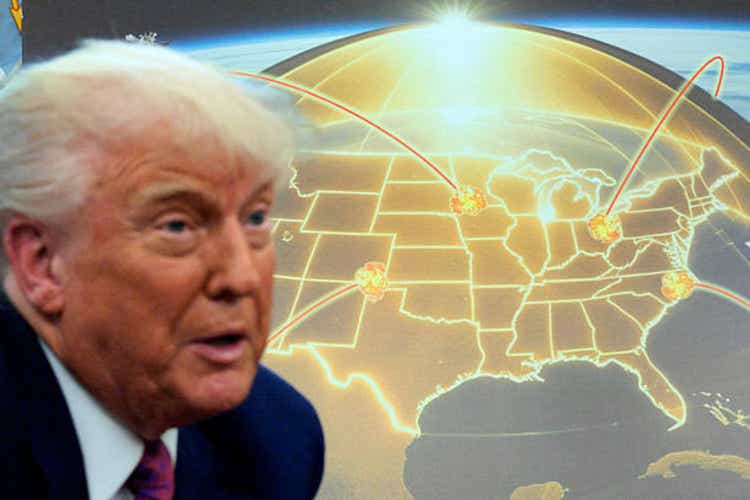
President Donald Trump on Tuesday formally introduced his concept for the “Golden Dome,” a proposed $175 billion missile defense initiative that would, for the first time, incorporate U.S. weaponry in space.
Speaking from the Oval Office, Trump said he anticipates the system could be “fully operational” by the end of his potential second term in 2029, with capabilities that could intercept missiles “even if they are launched from space.”
While Trump expressed confidence in the program’s timeline, a U.S. official familiar with its planning said it’s more realistic that the system might achieve partial readiness by then, given the complexity of the technology involved, the Associated Press reported.
New role for space in U.S. missile defense
Trump named Gen. Michael Guetlein, currently the vice chief of space operations, to oversee the project’s development. The Golden Dome system is envisioned as a multilayered defense platform capable of intercepting missiles during every phase of their trajectory — from pre-launch detection to terminal descent — using both terrestrial and space-based systems.
For months, the Pentagon has been developing a range of options for the system, categorized by cost as medium, high and “extra high.” All include some form of space-based interceptors — a major shift in U.S. defense posture. The key differences between the proposed versions lie in the number of satellites and onboard sensors involved, as well as the scale of new orbital weapons systems.
Cost projections and legislative hurdles
According to the Congressional Budget Office, the space-based components alone could cost up to $542 billion over two decades. Trump has proposed an initial $25 billion in funding as part of his broader tax policy legislation currently under consideration in Congress.
The United States allocated approximately $850 billion to the Department of Defense for fiscal year 2025. In addition, Congress last month unveiled a plan for an additional $150 billion in defense spending that would bring the total to approximately $1 trillion.
Amid the fanfare of Trump’s announcement, funding for the Golden Dome hasn’t yet been secured, and much of the program remains conceptual.
Air Force Secretary Troy Meink told lawmakers Tuesday that while the vision has been outlined by the president, the system’s official requirements are still under development. The Pentagon and U.S. Northern Command are in the process of drafting the initial capabilities document — a key step in defining what the system is expected to accomplish.
Rising threats from China and Russia
The Defense Department has long warned that emerging missile technologies from adversaries like China and Russia could overwhelm existing U.S. missile defense systems.
These nations have also developed offensive space capabilities, such as satellites designed to disable U.S. military infrastructure in orbit. Golden Dome’s emphasis on deploying interceptors in space is aimed at countering these evolving threats by enabling interception earlier in the missile’s flight path.
Gen. Chance Saltzman, head of the U.S. Space Force, told lawmakers Tuesday that Golden Dome represents a fundamental shift in U.S. defense strategy, pushing military space operations into uncharted territory.
The orbital weapons for Golden Dome “represent new and emerging requirements for missions that have never before been accomplished by military space organizations,” Saltzman said.
Nontraditional path forward
Unlike most defense programs, which begin with Pentagon requirements and evolve into system concepts, Golden Dome is being shaped in reverse, with the White House setting the vision and military planners now working to define the capabilities needed to fulfill it, the AP reported.
Some elements of the Golden Dome would incorporate existing U.S. missile defense assets, including ground-based Patriot systems and orbital missile-tracking satellites. Trump originally ordered the Pentagon to pursue space-based interceptors during the first week of his current presidency, signaling the initiative as a top defense priority.
U.S. defense contractors
Lockheed Martin (NYSE:LMT) announced its readiness to support the Golden Dome project. The company is evaluating various assets — including its command-and-control networks, F-35 stealth fighter and Sentinel A4 radar — to support the initiative. Lockheed Martin’s (NYSE:LMT) technology, like the TPY-6 radar and the PAC-3 Missile Segment Enhancement, has shown success in recent tests.
SpaceX (SPACE), led by Elon Musk, has emerged as a frontrunner to assist in developing the Golden Dome missile defense system. The company is collaborating with data analytics firm Palantir (NASDAQ:PLTR) and defense company Anduril to build crucial components of the system.
Their plan includes launching 400 to more than 1,000 satellites for tracking, alongside a separate fleet of 200 attack satellites potentially armed with missiles or lasers. However, SpaceX (SPACE) is expected to focus solely on satellite tracking, not weaponization.
BlueHalo, the defense technology company acquired by AV (AV), formerly known as AeroVironment, sees an opportunity for the Golden Dome project to encompass more than missile defense. The company advocates for integrating counter-drone capabilities and electronic warfare into the system, emphasizing the need for a comprehensive approach to modern threats.
RTX (NYSE:RTX), Northrop Grumman (NYSE:NOC) and General Dynamics (NYSE:GD) are also among the traditional defense contractors expressing interest in the Golden Dome initiative.
More on Lockheed Martin, General Dynamics, etc.
- Palantir Technologies: Time To Tread Carefully
- Palantir Will Likely Win The AI Race From America
- Most Expensive Mega-Cap In History: Should You Buy Palantir?
- Market momentum surges with 400 of the S&P 500 stocks above 50-day moving average
- Trump is said to tap Gen. Guetlein to lead ‘Golden Dome’ missile shield program