Chip Somodevilla/Getty Images News
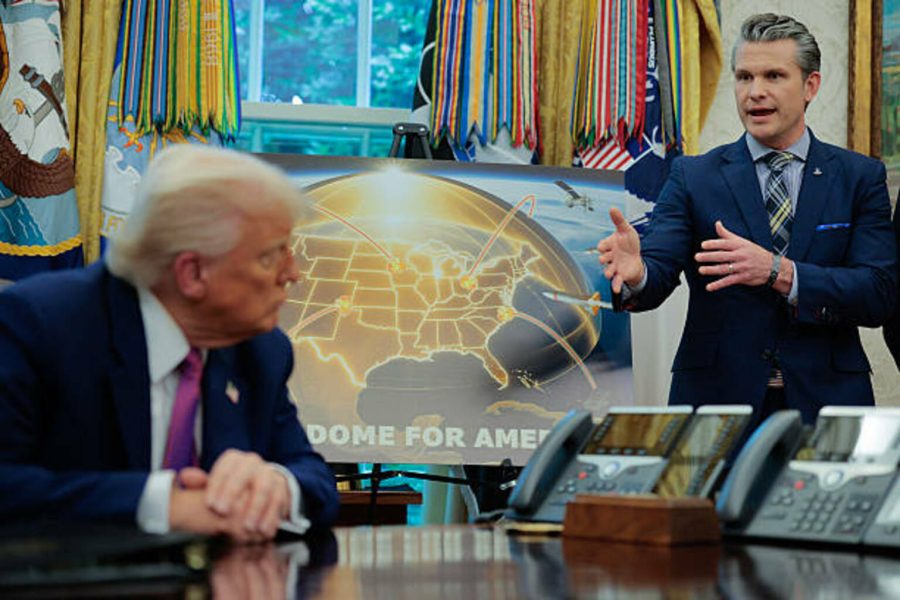
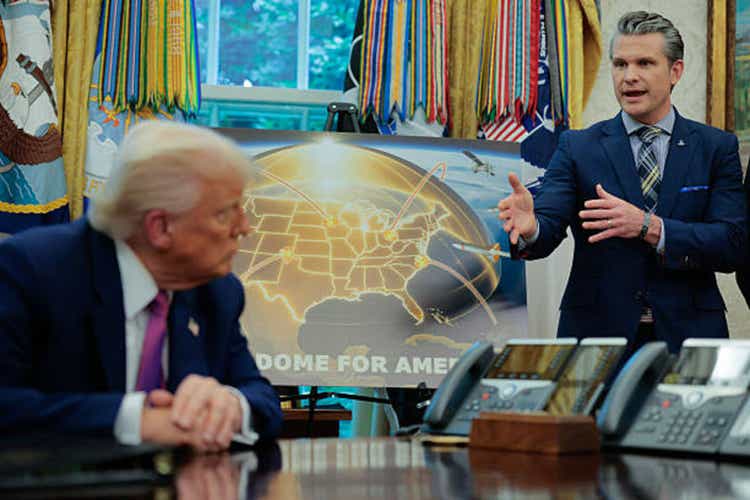
President Donald Trump’s ambitious missile defense initiative, dubbed “Golden Dome,” is beginning to take shape, and according to J.P. Morgan, the $175 billion project could generate significant near-term opportunities for U.S. defense contractors. Still, the proposed timeline and funding strategy may face hurdles.
In a research note published on Tuesday, J.P. Morgan analyst Seth Seifman said that while many details remain unclear, the Trump administration’s vision for Golden Dome is expansive.
The system is expected to defend against ballistic, cruise, hypersonic missiles and drones, with a target deployment date before the end of Trump’s current term — a deadline Seifman called “ambitious.”
Key figures and features
The program is projected to cost $175 billion, including $25 billion already earmarked in the 2025 reconciliation bill. General Michael Guetlein, vice chief of the U.S. Space Force, has been tapped to lead the initiative.
Top funding priorities include:
- Space-based sensors
- New interceptor technologies, including space-based options
- Non-kinetic interceptors, such as laser weapons
“These are mostly nascent capabilities, not refinements of existing systems,” Seifman said, pointing to the high risk of schedule delays and development challenges. For example, Lockheed Martin’s (NYSE:LMT) Next Generation Interceptor isn’t expected until at least FY30, while Northrop Grumman’s (NYSE:NOC) hypersonic interceptor may not be ready until 2035, even with acceleration.
L3Harris in the spotlight
Among defense firms, L3Harris (NYSE:LHX) received notable attention in Monday’s presidential briefing. Indiana Senator Jim Banks specifically highlighted the company’s missile-warning satellite work, including contributions to the Space Development Agency’s tracking layer and the Missile Defense Agency’s HBTSS program. L3Harris’s (NYSE:LHX) recently expanded facility in Fort Wayne, Indiana, positions it well to play a leading role.
L3Harris (NYSE:LHX) “is well-positioned within a portion of Golden Dome that should see a lot of resources,” said Seifman, adding that interceptor rocket motors may provide another avenue for the company to contribute.
Broad industry participation expected
Beyond L3Harris (LHX), major contractors such as Lockheed Martin (NYSE:LMT), Northrop Grumman (NYSE:NOC) and RTX’s (NYSE:RTX) Raytheon unit are also expected to benefit. Raytheon, for instance, recently delivered its first missile defense radar using a fully GaN-based array, which could be a key component of the new system.
The administration also emphasized participation from non-traditional players and smaller tech firms, with speculation that companies like SpaceX (SPACE), Palantir (NASDAQ:PLTR) and Anduril — previously reported by Reuters as being involved — may play a significant role in areas like AI, advanced sensors and autonomous systems.
An industry event initially scheduled for late April in Huntsville, Alabama has been postponed to June 11, where more concrete guidance on contractor roles is expected.
Political and fiscal uncertainty looms
Despite the scope and urgency of the project, J.P. Morgan cautions that its future may depend heavily on political continuity.
“The next administration may not be as committed to an initiative so closely tied to the current president,” Seifman warned.
Nevertheless, with defense spending on the rise and geopolitical tensions simmering, the Golden Dome initiative is likely to remain a top focus in the near term. For now, the race is on — not only to secure contracts, but to turn a bold vision into operational reality.