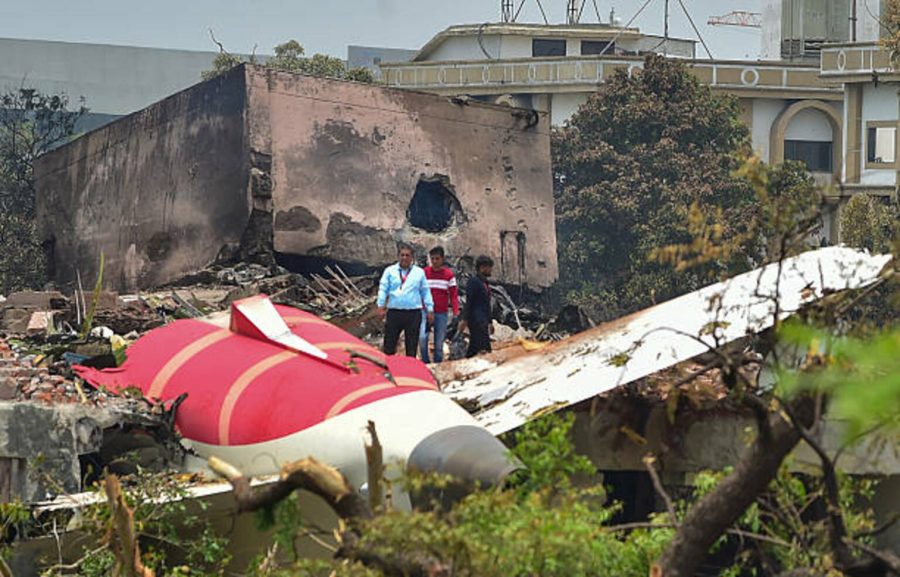
Boeing’s (NYSE:BA) share price in the past week was volatile as investigators worked to understand the deadly crash of an Air India Boeing (NYSE:BA) 787 Dreamliner, with early attention focused on the jet’s engines and a potential loss of lift shortly after takeoff, Barron’s reported.
The crash, which occurred on June 12, involved Air India Flight 171 en route to the United Kingdom. The aircraft, a 12-year-old 787 powered by GE Aerospace (NYSE:GE) engines, went down shortly after departure, killing 241 of the 242 people on board. As of last week, the death toll had risen to nearly 280, including individuals on the ground, with the final number expected to climb.
Indian authorities, who are leading the investigation, have yet to issue an official statement, but video footage from the crash site appears to show deployment of the aircraft’s Ram Air Turbine (RAT). The device is a small, emergency propeller system designed to provide backup electrical and hydraulic power in the event of a major systems failure.
Aviation experts said RAT deployment typically signals severe electrical or engine failure, though it’s too early to pinpoint the cause, according to Barron’s. Dual engine failure on a 787 is considered extremely rare, as the aircraft is designed to operate with one engine in emergency situations.
The jet’s black boxes, its flight data and cockpit voice recorders, have been recovered and are expected to provide critical information in the coming days. The recorders may be sent to the United States for further analysis.
Boeing (NYSE:BA) and GE Aerospace (NYSE:GE) have not publicly commented on the probe, in line with global aviation protocols requiring manufacturers to defer to regulatory authorities during active investigations.
The crash marks the first fatal accident involving the 787, a twin-aisle jet that entered commercial service in 2011. Air India operates more than 30 Dreamliners in its fleet, and inspections of those aircraft reportedly turned up no immediate safety concerns. Nonetheless, heightened scrutiny has led to some flight disruptions.
Earlier this week, an Air India 787 departing from Hong Kong returned to the airport shortly after takeoff due to an unspecified technical issue. The incident, while raising concerns, has not been linked to last week’s crash.
The accident has weighed on both Boeing (BA) and GE (NYSE:GE) shares. Boeing stock remains down roughly 8% since the crash, while GE Aerospace shares have slipped 4%.
Separately, Boeing (BA) is also facing new scrutiny from U.S. regulators. The National Transportation Safety Board recently issued a safety recommendation for 737 Max aircraft, warning of potential smoke in the cabin if birds are ingested into the engine. Boeing (BA) and GE (GE) have said they will work on any necessary modifications, though the advisory is not expected to disrupt normal operations.
The unfolding investigation coincided with last week’s Paris Air Show, a major event for aircraft orders and industry announcements. Boeing (BA) Chief Executive Kelly Ortberg canceled his appearance at the show, while GE (GE) postponed its planned investor event.