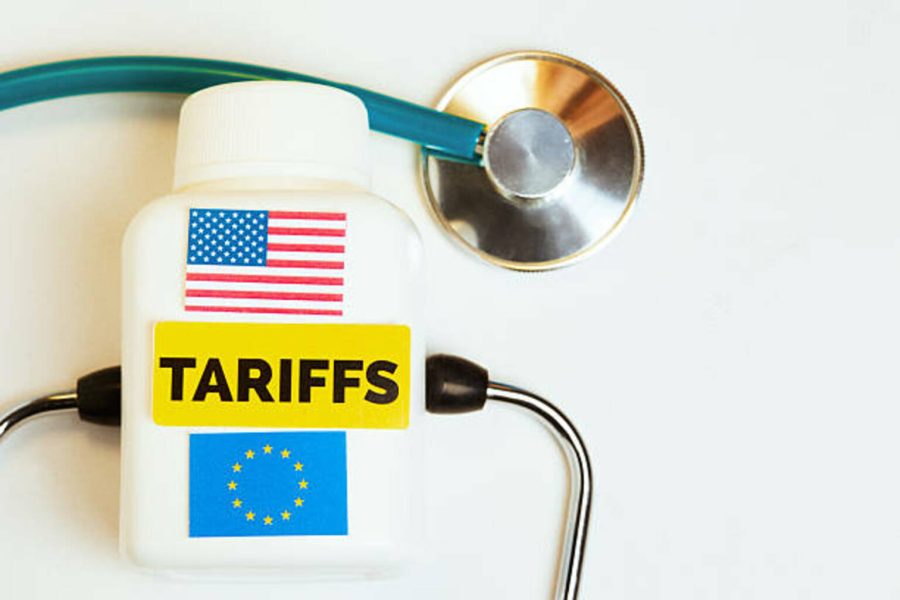
Major pharmaceutical companies traded higher on Thursday after the White House released new details about the recently signed U.S.–EU trade deal, indicating that tariffs on European pharmaceutical products will be capped at 15%.
The move contrasts with President Donald Trump’s recent threats to increase pharma tariffs up to 250% amid a so-called Section 232 investigation aimed at evaluating the impact of U.S. drug imports on national security.
The EU pharma sector, the biggest supplier of pharmaceutical products to the U.S., appears to have welcomed the news, with leading European drugmakers such as Novo Nordisk (NVO), GSK (GSK), Sanofi (NASDAQ:SNY), and AstraZeneca (AZN) all trading higher.
SPDR S&P Pharma ETF (XPH) gained ~1% to reach its highest level since November, while VanEck Pharma ETF (NASDAQ:PPH), which represents 25 of the top global drugmakers, traded higher for the third straight session.
However, Swiss pharma majors Novartis (NVS) (OTCPK:NVSEF) and Roche (OTCQX:RHHBY) (OTCQX:RHHBF) traded lower.
Earlier this month, imports from Switzerland, excluding Swiss-made pharmaceuticals, faced 39% trade levies imposed by the Trump administration.
According to a White House fact sheet released on Thursday, generic medicines imported from the EU will only be subject to the Trump administration’s most-favored-nation drug pricing policy, which aims to lower the U.S. drug prices to those in other developed nations.
In a Q&A document, the European Commission stated that MFN tariffs applied to generics could be effectively zero or close to zero. Generic drugmakers include Teva Pharmaceutical Industries (NYSE:TEVA), Viatris (VTRS), Amphastar (AMPH), and Amneal Pharmaceuticals (AMRX).
Meanwhile, tariffs on other EU-made pharmaceutical imports will not exceed 15% even after the finalization of the Section 232 national security investigation, according to the White House fact sheet.