Zoox (ZOOX) posted an update on Wednesday outlining redundancy in its robotaxi and the multi-layered safety and reliability philosophy guiding every aspect of its autonomous vehicle design.
The company emphasized that true self-driving service must account for rare and unexpected failures in both hardware and software by embedding backup systems throughout the vehicle, including with the drive, steering, sensing, battery, and computing modules. The robotaxi’s sensor suite integrates cameras, radar, and lidar arrays with overlapping 360-degree coverage, making the vehicle resilient to single-point sensor failures and ensuring situational awareness even in exceptionally complex or adverse conditions.
Zoox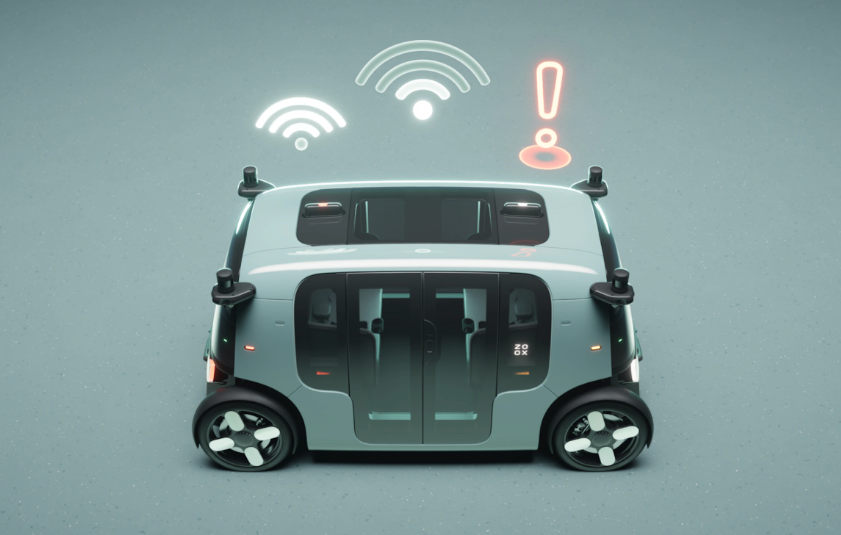
Of note, Zoox’s (ZOOX) critical actuators, which are responsible for steering and braking, also feature independent redundant channels, so the robotaxi remains in control even if one pathway is compromised. Power comes from dual battery packs with separate energy supplies, allowing uninterrupted operation during a pack failure, and the central compute system is built with mirrored logic domains to cross-verify performance in real-time.
Alongside physical redundancy, Zoox (ZOOX) noted that the software stack is constantly surveyed for faults at every layer, triggering fail-safe protocols or a minimal risk condition when anomalies appear.
Founded in 2014 by Tim Kentley-Klay and Jesse Levinson, Zoox (ZOOX) was acquired by Amazon (NASDAQ:AMZN) in 2020 for over $1 billion, providing vast resources and positioning it within Amazon’s hardware innovation division.
Looking ahead, Zoox (ZOOX) plans to continue to focus on scaling from pilot testing to full commercial deployment of its purpose-built robotaxis. The company is launching its first ride-hailing service for the public in Las Vegas later this year. Meanwhile, the company’s state-of-the-art facility in Hayward, California, is being designed to eventually produce up to 10,000 robotaxis per year. Zoox (ZOOX) is also conducting extensive on-street testing not only in Las Vegas but in San Francisco, Atlanta, Seattle, Austin, Miami, and Los Angeles, preparing those metro areas for future expansion.