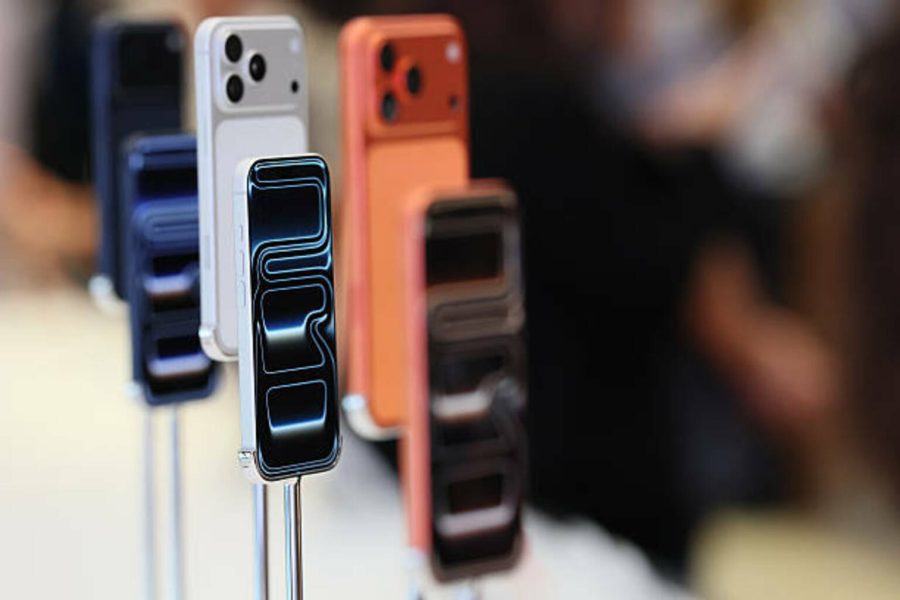
Apple’s (NASDAQ:AAPL) iPhone 17 lineup reviewers seemed to agree that choosing the iPhone 17 “no longer means missing out,” as the company brought most of the important features over to its standard phone.
The iPhones went live on sale on Friday.
iPhone 17
“Apple has slowly whittled down that list by bringing the most important features over to its standard phone, but the two biggest exclusions have, until now, remained: the always-on display and high-refresh-rate screen,” said Jacob Kastrenakes, The Verge’s executive editor.
Kastrenakes said after testing the iPhone 17 he found that the addition of these two features has meaningfully improved the experience of using the base iPhone.
“The iPhone 17 feels faster, easier to use, and more convenient as a result of these upgrades,” Kastrenakes added.
“And for the first time in a while, choosing the standard iPhone no longer means missing out,” Kastrenakes noted.
The iPhone 17 starts at $799, has a larger screen, 6.3 inches, up from 6.1 on the iPhone 16, with a faster 120-hertz refresh rate. The phone also has a new A19 processor and starts with 256 GB of storage.
“The standard iPhone 17 also brings an improved rear camera and a vastly better selfie camera that will likely be a welcome upgrade for mainstream consumers. But in terms of hardware design, it’s the most familiar-looking of the bunch,” said Bloomberg News’ Chris Welch and Samantha Kelly while reviewing the phones.
“This is the iPhone most people should get. It has the battery and camera boosts, said Nicole Nguyen from the Wall Street Journal. “It also has a new Pro-level smooth-refreshing screen that can be both brighter and dimmer than the one on last year’s model.”
However, Kastrenakes did note that the most obvious thing the iPhone 17 does not get “is the flashy new camera bar design seen on the iPhone 17 Pro and the iPhone Air.”
iPhone Air, iPhone 17 Pro and Pro Max
The iPhone Air dominated media coverage ahead of the event. The phone has replaced the iPhone Plus segment.
“If the Air is a nod to the future, the iPhone 17 Pro and Pro Max are a showcase for what Apple can achieve with a thicker, more conventional form factor. Both should be popular choices,” said Welch and Kelly.
However, WSJ’s Nguyen noted that each model has more battery life than its predecessor with one exception, the iPhone Air.
She reviewed the phones and found that after a day of use (8 a.m. to 10 p.m.) on a mix of 5G and Wi-Fi, the battery percentage left in the phones were the following: iPhone Air: 19%, iPhone 17: 27%, iPhone 17 Pro: 30%, and iPhone 17 Pro Max: 54%.
Nguyen said that in new iPhones, the front camera received a noticeable upgrade. Selfie videos are now stabilized. Even a jog over rocky terrain looked smooth. The 18-megapixel camera takes sharper, higher-resolution selfies, according to Nguyen.
“In the Air’s favor, it has a 6.5-inch screen, compared to the 17’s 6.3-inch, yet is lighter to hold. It also has the A19 Pro chip, rather than the A19 chip. But oddly, this isn’t the same Pro chip that’s in the Pro phone. It has a 6-core CPU with a 5-core GPU. That’s similar to the A19 in the 17. (The Pro model has a 6-core CPU and 6-core GPU), said TechCrunch’s Julie Bort.
Separately, TechCrunch’s Lauren Forristal said that Apple’s move to bring in the iPhone Air appears to be the company’s response to the trend of slimmer smartphones, following in the footsteps of other companies like Samsung Electronics (OTCPK:SSNLF) and Huawei Technologies.
Forristal added that the iPhone Air could potentially outshine the Samsung Galaxy S25 Edge, which measures 5.8 mm thick. “Additionally, it may pave the way for Apple’s long-rumored foldable phone, predicted to launch in September 2026, Forristal noted.
In Cameras, iPhone 17 Pro and 17 Pro Max add a third lens, a telephoto (now also 48 megapixels) for true optical zoom up to 4 times and “optical-quality” up to 8x.
“Compared with the non-Pros, I saw the biggest difference with videos—they’re more stable and they sound better,” said WSJ’s Nguyen.
The cheapest Pro model is going to cost starting from $1,099, compared to the starting price of $999 for last year’s phones, but it is also getting twice as much storage.
For the iPhone 17 Pro Max, WSJ’s Nguyen, “I never understood the Max until I tested this one. You never have to worry about the battery draining. The 6.9-inch screen—Apple’s biggest—is so nice to look at.”
Bloomberg News’ Mark Gurman said that while not a matter of practicality, the Pro versions also offer fresh outer designs that could tempt buyers.
“The iPhone 17 Pro looks entirely different from the back — and let’s not discount how the new orange color might do. People are going to line up for it, I’m sure,” said Gurman.
Concluding, Nguyen said that “if your current phone is going strong and compatible with iOS 26, you might not need to upgrade at all.”
“Analysts are pointing to 2026 as a potentially bigger year of updates, with a foldable iPhone at the high end. We might also finally see promised AI upgrades, such as a smarter Siri—the real change we’re all waiting for,” Nguyen noted.