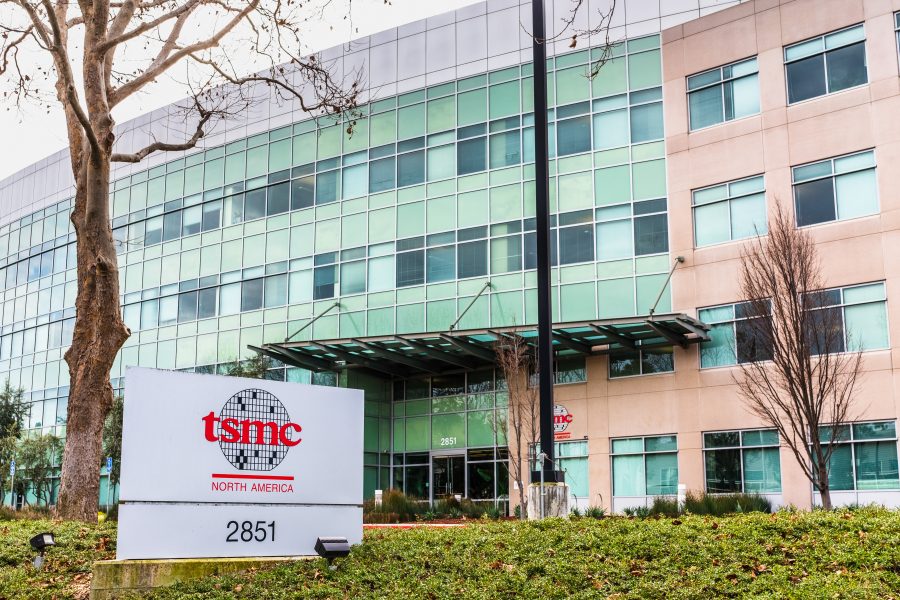
Taiwan Semiconductor Manufacturing (NYSE:TSM) has further expanded its dominance in the semiconductor foundry space, as evidenced by its recent third-quarter financial results, where its revenue reached $33.1B.
TSMC shares ticked up 2% during early Monday trading.
“This achievement reflects strong traction at 3nm and sustained high utilization at 4/5nm, supported by ongoing orders from AI GPU and HPC customers as well as premium smartphone platforms,” according to analysis by Counterpoint Research.
Apple (AAPL) has led to TSMC’s ramp-up of 3nm production, while Nvidia (NVDA) and AMD (AMD) continued to drive high demand for 4nm and 5nm chips, the analysts said. This has maintained capacity at full utilization. Hyperscalers are also driving up demand at TSMC. This includes Google’s (GOOG)(GOOGL) TPUs, Amazon Web Services (AMZN) Tranium chips and Meta Platform’s (META) MTIA accelerators.
Foundry competitors such as Samsung (OTCPK:SSNLF) and Intel (NASDAQ:INTC) still trail TSMC by a significant share, but are making some progressive steps, the firm said.
“Regarding the commercial timeline, Intel projects that wafer commitments to its foundry customers will begin in 2026, with high-volume production and lead customers expected to ramp up between 2026 and 2027,” Counterpoint noted. “Intel has also pivoted its foundry strategy to be customer-commitment driven rather than building speculative capacity. This shift ensures that capacity expansion is directly tied to confirmed demand.”
Counterpoint also said Samsung’s advanced process utilization and wafer consumption increased during the second quarter of 2025 and are expected to continue for the rest of the year. This is due in part to smartphone chips based on 2nm technology.
“Going forward, the outlook for Samsung’s advanced nodes will largely depend on the success of its 2nm chips,” Counterpoint said. “Beyond its in-house Samsung Exynos lineup, the outcome of its collaboration with Tesla (TSLA) in the coming years will be a key factor determining whether Samsung can attract more customers and secure additional orders in the advanced process node.”