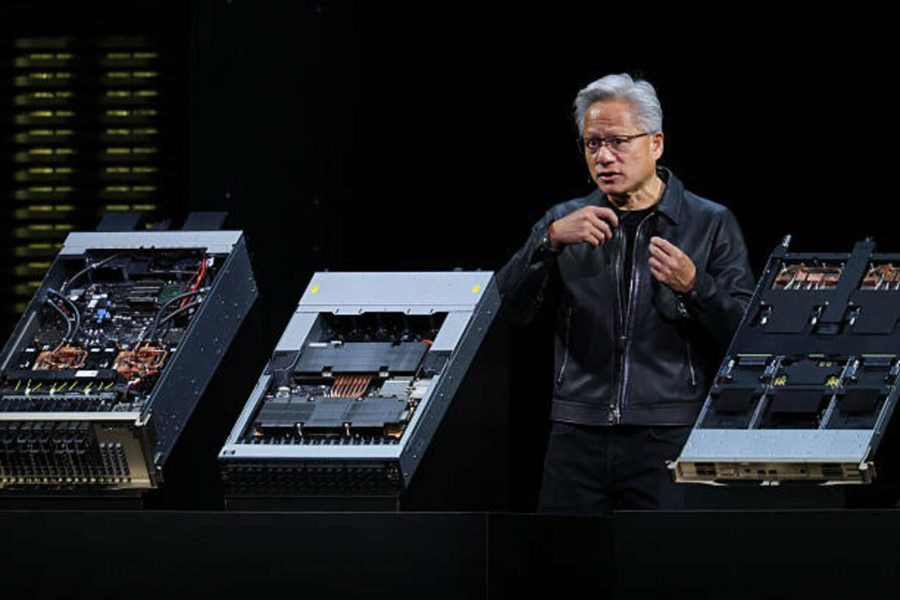
Nvidia (NVDA) CEO Jensen Huang said AI has started the largest infrastructure buildout in human history, and more energy, land, and skilled workers are needed, as he discussed the breakthrough technology with BlackRock’s (BLK) CEO Larry Fink at the World Economic Forum in Davos, Switzerland, on Wednesday.
AI Infrastructure
Jensen said the AI is essentially a “five-layer cake,” with energy being the first, followed by chips and computing infrastructure, cloud infrastructure and cloud services, AI models, and the final being the application layer, which we all need to succeed.
“This application layer could be in financial services, it could be in healthcare, it could be in manufacturing. This layer on top ultimately is where economic benefit will happen. But the important thing though, because this computing platform requires all of the layers underneathit, it has started, and you guys are everybody’s seeing it right now, it has started the largest infrastructure build out in human history,” said Huang.
Huang stressed the importance of infrastructure building.
“We’re now a few hundred billion dollars into it. We’re a few hundred billion dollars into it. Larry and I, we get the opportunity to work on many projects together. There are trillions of dollars of infrastructure that needs to be built out. And it’s sensible. It’s sensible because all of these contexts have to be processed so that the AI, so that the models can generate the intelligence necessary to power the applications that ultimately sit on top,” Huang noted
Huang said that in the chip sector, Taiwan Semiconductor Manufacturing Company (TSM) announced that it is going to build 20 new chip plants. “Foxconn (FXCOF) working with us and Wistron and Quanta building 30 new computer plants, which then go into these AI factories,” Huang added.
“Micron started investing $200 billion in the United States. SK hynix is doing incredibly. Samsung is doing incredibly. You can see that entire chip layer growing incredibly today,” Huang commented.
Huang said that 2025 was one of the largest in venture capital funding, with over $100B globally, and most of the funding went to AI native companies in healthcare, robotics, manufacturing, and financial services, among others.
AI and Jobs
Huang was also asked if AI and robotics are changing the nature of work rather than eliminating it.
“First of all, this is the largest infrastructure build-out in human history. That’s going to create a lot of jobs. And it’s wonderful that the jobs are related to tradecraft. And we’re going to have plumbers and electricians and construction and steel workers and network technicians and people who install and fit out the equipment and all of these jobs. In the United States, we’re seeing quite a significant boom in this area,” Huang commented.
AI Bubble?
Huang said that one good test on the AI bubble is to recognize that Nvidia now has millions of Nvidia Graphics Processing Units, or GPUs, in the cloud, and they are being used everywhere. And if anyone tries to rent an Nvidia GPU these days, is incredibly hard.
“And the spot price of GPU rentals is going up, not just the latest generation, but two generation old GPUs. The spot price of rentals are going up. And the reason for that is because the number of AI companies that are being created, the number of companies shifting their R&D budget,” Huang noted
Huang added that R&D budget is going to shift towards AI. “And so the AI bubble is, comes about because the investments are large. And the investments are large, because we have to build the infrastructure necessary for all of the layers of AI above it,” Huang noted.
“We need more energy. I think that we all recognize that. We need more land power, ” said Huang, adding that we need more trade skill workers.”
Europe and AI
Huang said that robotics is a once-in- -generation opportunity for the European nations.
The Nvidia CEO noted that the industrial manufacturing base in Europe is incredibly strong, and this is the opportunity for the region to leap past the era of software.
“The United States really led the era of software. AI is software that doesn’t need to write software,” said Huang. “And so get in early now so that you can now fuse your industrial capability, your manufacturingcapability with artificial intelligence. And that brings you into the world of physical AI or robotics. Robotics is a once in a generation opportunity for the European nations.”
Nvidia and Anthropic (ANTHRO)
Huang also praised Anthropic’s (ANTHRO) Claude for coding capabilities and OpenAI’s (OPENAI) ChatGPT in the consumer space.
“Anthropic has made a huge progress, huge lead in developingCloud. We use it all over our company. The coding capability of Cloud, its reasoning capability, its ability is just really incredible. And anybody who has a software company really ought to get involved in and use it. On the other hand, ChatGPT is probably the most successful consumer AI in history. And its ease of use and its approachability, I think everybody should get involved,” Huang noted.
On Tuesday, Anthropic (ANTHRO) CEO Dario Amodei talked about the disruptive AI technology, competition from Big Tech AI companies, and potential IPO plans at the World Economic Forum.
In November 2025, Nvidia (NVDA) and Microsoft committed to invest up to $10B and up to $5B, respectively, in the Claude chatbot maker Anthropic — which is backed by Amazon (AMZN) and Alphabet’s (GOOG) (GOOGL) Google. Anthropic also said it has committed to spending $30B on Microsoft’s Azure compute capacity and to contracting additional compute capacity up to one gigawatt.