An agreement to speed up production of the U.S. Air Force’s B-21 stealth bomber could lift long term free cash flow at Northrop Grumman (NOC), even as it requires billions of dollars in added capital spending, according to a report from UBS.
UBS analyst Gavin Parsons on Tuesday reiterated a Buy rating on Northrop Grumman (NOC) and set a 12 month price target of $778, implying about 7% upside from Monday’s closing price of $727.73.
Air Force agreement boosts yearly production capacity
Northrop Grumman (NOC) this week said it reached an acceleration agreement with the Air Force that will use $4.5 billion of reconciliation funding to increase annual B-21 production capacity by 25% and compress delivery timelines.
B-21 Raider (Northrop Grumman) 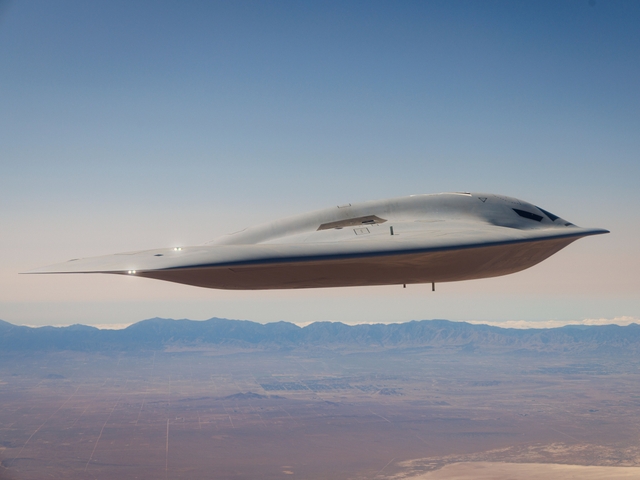
UBS said the faster ramp will require an estimated $2 billion to $3 billion of additional capital expenditures spread over several years. The firm is modeling $2.5 billion of capex allocated evenly between 2026 and 2029.
The approved program of record remains 100 aircraft, though some officials have advocated for 145 or more. UBS said higher production rates could allow Northrop (NOC) to reach higher margin units sooner, a potential positive for returns. However, pricing for full rate production has not yet been finalized, leaving uncertainty around ultimate profitability.
Scenario analysis points to 2030 free cash flow upside
UBS updated its B-21 financial model to reflect the higher capex. In both of its acceleration scenarios, the firm sees roughly 5% upside to free cash flow in 2030 and beyond, even assuming deflationary pricing tied to larger program quantities.
In its base case, which doesn’t assume acceleration, UBS models peak production of seven aircraft per year by 2029 and 105 total units. Low-rate initial production, or LRIP, lots one through five are assumed to generate no margin, with profitability beginning in LRIP six and beyond.
Under Scenario 1, UBS assumes accelerated production, $2.5 billion of added capex and an expanded program of record to 141 aircraft. Peak production would reach 10 aircraft per year by 2030, with seven per year achieved in 2028, one year earlier than in the base case. That scenario results in double digit free cash flow downside between 2026 and 2029, followed by about 5% upside in 2030.
Scenario 2 mirrors the faster build rates and higher aircraft total but assumes not to exceed pricing for LRIP lots three through five and partial capex offsets from the government. In that case, UBS sees low single digit average upside to free cash flow between 2026 and 2030.
Returns dependent on pricing, capex recovery
UBS said the acceleration agreement increases the probability of stronger free cash flow in 2030 and beyond, but pricing terms for full rate production and the extent of government support for capex will be key in determining ultimate returns.
While details remain limited, the firm views the move toward faster production and potentially larger quantities as strategically favorable for both Northrop Grumman (NOC) and the government, particularly if it allows inflation catch up after earlier fixed price LRIP lots.