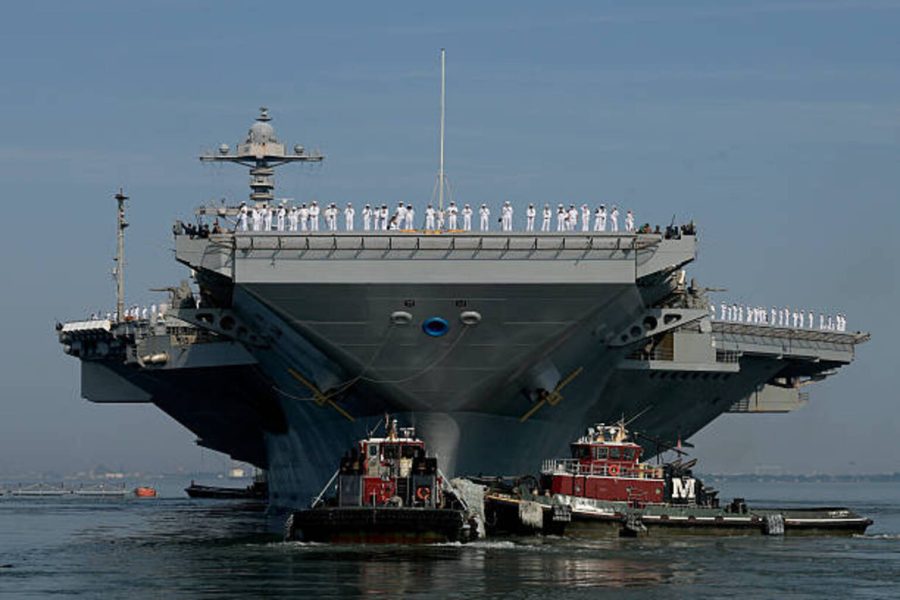
The market narrative that cheap drones will quickly replace expensive aircraft and surface ships is colliding with reality. Recent U.S. operations against Iran show the Pentagon still leans on manned fighters, bombers and naval destroyers for the bulk of high-end strike and air defense missions, a point investors are watching closely across aerospace, munitions and shipbuilding, The Wall Street Journal reported Thursday.
Drones have reshaped combat in Ukraine and helped fuel predictions that traditional platforms are becoming obsolete. But in the Middle East, the U.S. has largely relied on conventional air and sea power, using large numbers of aircraft to hit targets while destroyers launched cruise missiles and helped defend against retaliatory attacks.
An F/A-18F Super Hornet aircraft lands on the world’s largest aircraft carrier, USS Gerald R. Ford, while operating in the Eastern Mediterranean Sea in support of Operation Epic Fury. (U.S. Navy) 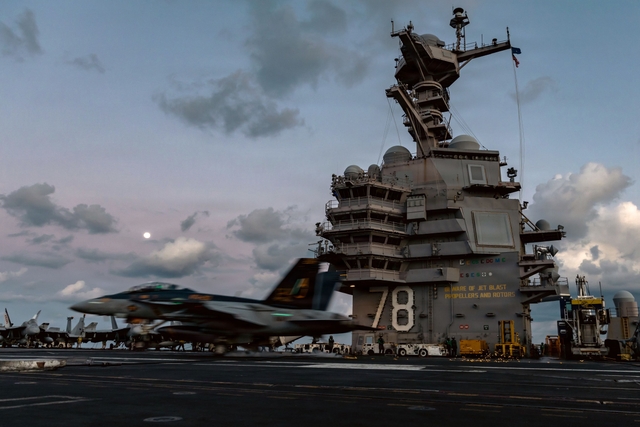
Uncrewed systems still mattered. The U.S. used one-way attack drones and Iran launched large waves of UAVs at nearby states and U.S. positions. Even so, analysts argue today’s drones often struggle to match the combination of range, survivability, sensors, payload and adaptability that front-line fighters and bombers provide.
The gap is most obvious in weapons weight and mission flexibility. Cruise missiles launched from ships can carry far larger warheads than typical attack drones, and heavy bombers can deliver very large bunker-penetrating munitions that current UAVs cannot lift. Drone links can also be disrupted by electronic warfare, while crewed aircraft can adjust in real time when conditions change.
Naval vessels are also acting as mobile air-defense nodes. U.S. destroyers played a central role in protecting U.S. and allied targets, reinforcing the investment case for surface combatants, air-defense interceptors, sensors and battle-networking systems.
None of that diminishes the drone shift. UAVs are increasingly used for surveillance, strike and saturation tactics, and the U.S. is expanding purchases of lower-cost models designed for rapid deployment. The Pentagon is also developing “Collaborative Combat Aircraft,” designed to operate alongside crewed fighters and take on high-risk missions, the Journal reported.
The constraint for now is capability and scale. Investors should read the current posture as a dual-track procurement story: accelerated demand for drones and autonomy, alongside sustained spending on crewed aircraft, naval platforms and the high-end munitions and air-defense systems that remain central in major combat scenarios, especially against more advanced opponents.