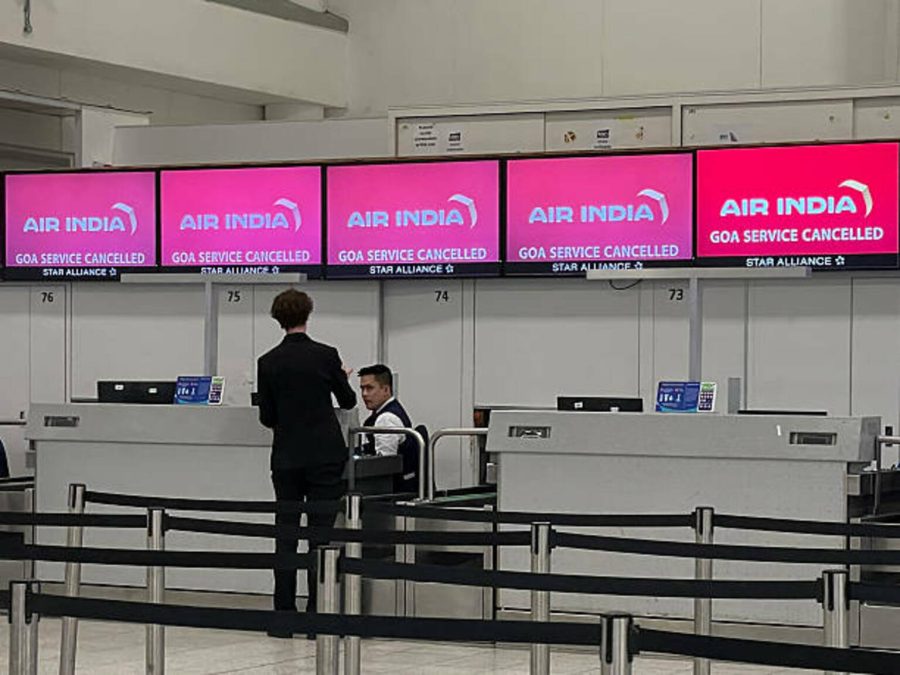
A catastrophic crash involving an Air India Boeing (NYSE:BA) 787-8 just seconds after takeoff from Ahmedabad is expected to center investigators’ attention on the aircraft’s configuration during the critical early phase of flight, The Wall Street Journal reported, citing aviation safety experts.
The London-bound jet went down in a residential area less than a minute after departure, killing 241 of the 242 people on board. It marks the first fatal crash involving Boeing’s (NYSE:BA) Dreamliner aircraft.
Indian authorities have opened an inquiry with support from the U.S. National Transportation Safety Board, which will send investigators to assist in the probe. The investigation is expected to rely heavily on the aircraft’s flight-data recorder, cockpit-voice recorder and video footage captured by bystanders in the flight’s final moments.
Flight-tracking data from Flightradar24 indicates the aircraft reached an altitude of 625 feet in clear conditions before it abruptly stopped transmitting location data, just 50 seconds after takeoff.
According to aviation experts cited by the Journal, several early indicators suggest investigators will likely focus on whether the aircraft was correctly configured for takeoff.
Key among those factors are the position of the flaps and slats, the movable surfaces on the wings that increase lift during takeoff. Initial analysis has raised questions about whether those systems were extended as required, John Cox, an aviation-safety consultant and former airline pilot, said to the Journal.
The Dreamliner is equipped with a warning system that alerts pilots if the aircraft is not properly configured for takeoff. Investigators are likely to seek to determine whether that system functioned correctly, and if so, whether the crew received and responded to the alert.
The aircraft’s landing gear also appeared to still be extended during flight, a detail that could be relevant to drag and lift performance calculations. Experts noted that while a delay in retracting the gear is not unusual, its combination with a possible lift deficit and increasing pitch could have been a dangerous mix.
Engine performance will also be closely examined. According to Jeff Guzzetti, a former senior investigator with both the FAA and NTSB, the absence of yaw or rudder deflection in the aircraft’s final trajectory may indicate that a single-engine failure is unlikely, the Journal reported.
The Dreamliner involved in the crash was 11 years old. While the 787 is among Boeing’s (BA) bestselling widebody aircraft, the program has faced several production disruptions in the past decade, including quality-control issues that temporarily paused deliveries.
Air India, formerly state-run, was acquired by Tata Sons in 2022. The airline has since placed a record aircraft order in a bid to modernize its fleet and improve its safety record. The last fatal incident involving the carrier occurred in 2020, when an Air India Express plane overran a runway in Kerala.
More on Boeing
- Boeing: Unlocking The $50 Billion Win For The MAX
- The Boeing Company (BA) Bernstein 41st Annual Strategic Decisions Conference (Transcript)
- Boeing And Airbus Climb On $40 Billion Order Surge: Which One Is Leading The Recovery?
- Boeing’s stock falls as Air India crash raises more safety questions
- Air India crash marks deadliest aviation disaster in a decade