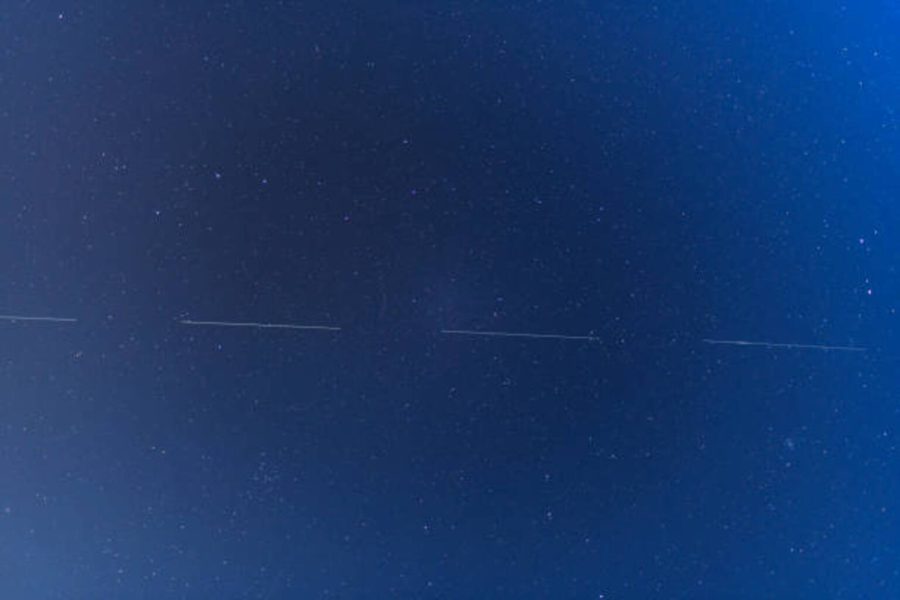
The battle for the heavens is going into overdrive after Blue Origin (BORGN), the space company owned by Amazon (AMZN) founder and executive chair Jeff Bezos, announced plans for a new satellite constellation. The network, called TeraWave, will feature 5,408 satellites that aim to meet increasing demand for space-based communication. It marks a big expansion by the company, which has until now been focused on suborbital space tourism and the development of its heavy-lift New Glenn rocket.
The competition: Interestingly, Amazon (AMZN) has a satellite venture called Leo, which was started under Bezos as Project Kuiper (coming merger or partnerships?). Elsewhere, AST SpaceMobile (ASTS), which is involved in the space-based connectivity market, tumbled 8% on the TeraWave news. However, the biggest real rival is Starlink (STRLK), which was founded by tech billionaire Elon Musk. Starlink (STRLK) already has 9,000 satellites in orbit, which have been instrumental in providing internet service to consumers across the globe, and doubled its customer base to 9M active subscribers over the past year.
The services are still a bit different. Blue Origin’s (BORGN) TeraWave, which is targeting deployment for the fourth quarter of 2027, is being designed to serve data centers, enterprise users, and governments. Its system will provide whopping data speeds of up to 6 terabits per second through a multi-orbit approach. In contrast, Starlink (STRLK) primarily serves the mass market with internet and phone services, with overall lower speeds and data applications.
How they work: Starlink’s (STRLK) Low Earth Orbit (LEO) satellites use radio frequency (RF) connectivity. It’s ideal for the public, as transmissions can pass through the atmosphere with very low latency. TeraWave is aiming for a hybrid network of LEO and Medium Earth Orbit (MEO) satellites. These can transmit data in the skies and to ground stations at an extremely high bandwidth by adding in infrared lasers (optical) that are highly secure and don’t need spectrum licenses.