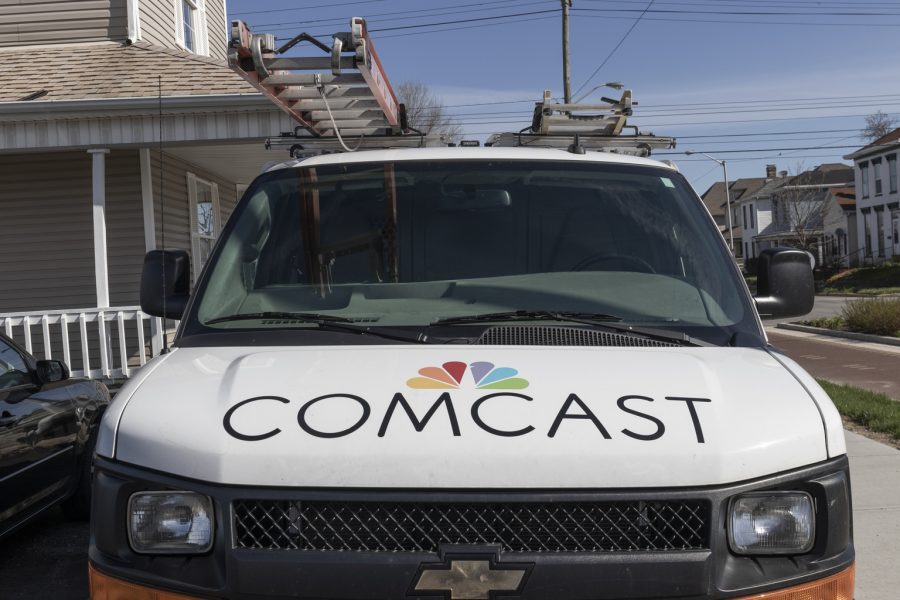
Comcast (CMCSA) is set to announce fourth-quarter earnings on Thursday, and investors will watch out for the company’s broadband subscriber trajectory and growth in theme park revenue as well as updates on media strategic initiatives.
Wall Street expects the telecommunication and media company to post an EPS of $0.76, implying a 20.8% decline year-over-year, while revenue is expected to rise 1.3% to $32.34B for the quarter.
Analysts believe that the broadband market remains fiercely competitive, as fiber and fixed wireless operators continue to capture share gains.
Wells Fargo Securities analysts issued a stark warning for cable operators, including CMCSA, forecasting cable companies could lose 1 million residential broadband subscribers in 2026.
BofA Securities analyst Jessica Reif Ehrlich projected a net loss of 200K broadband subscribers for Comcast in the fourth quarter. Ehrlich also reduced Comcast’s wireless net add forecast to 380K from a prior estimate of 400K.
However, BofA Securities reiterated its Buy rating with a price target of $37, saying that the recent spin-off of linear networks removes a legacy drag and spotlights NBCUniversal as a scarce growth asset, with Peacock nearing breakeven and Universal Theme Parks set to experience sustained growth for many years.
Wall Street analysts and Seeking Alpha’s Quant ratings are cautious and rated the stock a Hold. Seeking Alpha analysts, however, consider it a Buy.
KeyBanc Capital Markets rated the stock as Sector Weight, saying that Comcast is undergoing strategic investments to position the business to better compete in broadband, which are likely to pressure broadband ARPU and Connectivity & Platform EBITDA for at least the next couple of quarters.
Over the last two years, CMCSA has beaten EPS estimates 100% of the time and has beaten revenue estimates 75% of the time.
Over the last three months, EPS estimates have not seen any upward revisions and 18 downward revisions, while revenue estimates have seen seven upward revisions compared with 12 downward revisions.
The company’s stock fell nearly 25% in the last one year, compared to a 16% rise in the broader S&P 500 Index.