It was five years ago this month that GameStop (GME) became the epicenter of the financial world with a stunning rally led by retail investors that flipped the script on some notable hedge funds. What started as an underdog bet on a video game retailer turned into a cultural phenomenon with a story so dramatic it ended up on the big screen.
The seeds of the GameStop (GME) saga were planted in mid-2019 when investor Michael Burry’s Scion Asset Management acquired a stake in the company as a value play in a company that many had written off as a dying brick-and-mortar relic. Then in August 2020, Ryan Cohen, founder of online pet retailer Chewy (CHWY), revealed a 9% investment in the company, signaling that other notable investors also saw potential, despite Wall Street warnings. Then the retail trading community on Reddit’s WallStreetBets forum took notice, including Keith Gill (Roaring Kitty on YouTube), who had a sizable position in GameStop (GME) call options.
By early January 2021, GameStop (GME) had become one of the most heavily shorted stocks in the market, with approximately 140% of its public float sold short, and had several major hedge funds piling on. On January 4, GameStop closed at $17.25 per share. By January 11, Ryan Cohen had officially joined the company’s board of directors alongside two e-commerce specialists from Chewy, sending the stock jumping to an intraday high of $38.65 on January 13. On January 19, short-seller Citron Research tweeted that GameStop’s retail investors were “suckers at this poker game,” predicting the stock would fall back to $20. The following week saw a share price rally acceleration as the stock traded intraday to as much as 30 times higher than where it stood at the beginning of the month.
GME share price (split-adjusted) (Seeking Alpha) 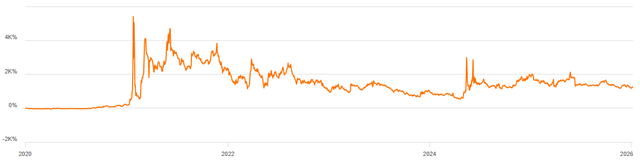
Controversy ensued when Robinhood Markets (HOOD) and several other retail trading platforms halted buying of GameStop (GME) shares during the circus, citing clearinghouse deposit requirements. While there were mini-rallies later in the year, nothing approached the drama of January 2021.
The GameStop (GME) meme rally swept other stocks into the wave, including BlackBerry (BB), Nokia, Bed Bath & Beyond, Tupperware (TUPBQ), Koss Corporation (KOSS), Wendy’s (WEN), Clover Health (CLOV), and Naked Brand Group, all of which saw wild trading of their own. Just last year, the meme trade was reignited briefly with stocks such as Opendoor Technologies (OPEN), Beyond Meat (BYND), Krispy Kreme (DNUT), and Kohl’s (KSS) seeing retail-led rallies.
Today, GameStop (GME) has undergone significant changes under new CEO Ryan Cohen. His strategy has focused on aggressive cost-cutting, business diversification beyond video games, and building a substantial cash hoard. During Q3, sales were down 4.6% year-over-year to $821M; however, the company showed a profit and a fortress balance sheet. Still, the challenges facing GameStop in achieving future growth are substantial. While collectibles and trading cards offer some promise, scaling those categories may not be enough to drive revenue growth unless there is a major strategic acquisition or entirely new business line.
Shares of GameStop (GME) are down 33% over the last 52 weeks. Short interest on GME of 15.2% of the total float is bubbling under the surface.