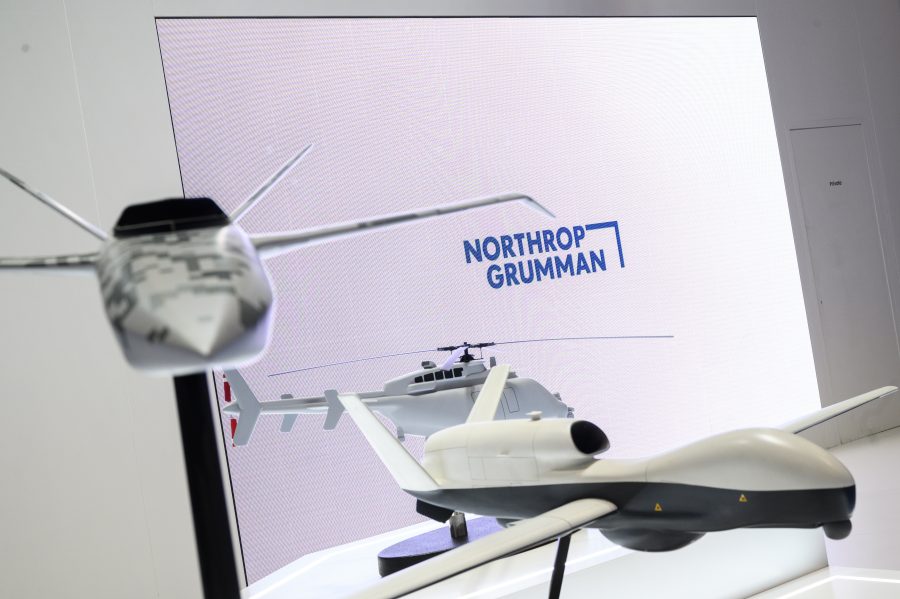
Northrop Grumman (NOC) on Monday said it’s moving forward in the race to field autonomous combat aircraft, announcing that its Talon Blue platform has been designated the YFQ-48A by the U.S. Air Force as part of the service’s Collaborative Combat Aircraft program.
The YFQ-48A Talon Blue is the Air Force variant within Northrop Grumman’s (NOC) internally funded Project Talon portfolio, which focuses on developing modular, lower-cost and rapidly deployable autonomous aircraft designed to operate alongside crewed fighter jets. The designation signals formal alignment between the company’s efforts and the Air Force’s push to accelerate acquisition of next-generation autonomous systems.
For investors, the shift toward autonomous military systems signals a potential multiyear growth cycle for defense contractors with strength in software, artificial intelligence, advanced manufacturing and scalable production.
As militaries around the world prepare for more contested, data-driven battlefields, autonomous systems are increasingly seen as essential force multipliers rather than experimental add-ons. From Ukraine to the Indo-Pacific, drones and AI-enabled platforms have demonstrated how lower-cost, unmanned systems can extend reach, absorb risk and accelerate decision-making without putting pilots or soldiers directly in harm’s way.
The U.S. Air Force’s Collaborative Combat Aircraft program reflects this shift, aiming to pair crewed fighters with autonomous “wingmen” that can conduct surveillance, electronic warfare or strike missions in tandem. Similar initiatives across Europe and Asia underscore a broader strategic pivot: autonomy is becoming central to airpower doctrine, procurement strategy and deterrence planning in an era defined by speed, scale and survivability.
Digital backbone
Northrop Grumman (NOC) said Talon Blue is designed to function as an autonomous “wingman,” supporting piloted aircraft in contested environments. The aircraft leverages advanced modular manufacturing methods intended to reduce part counts and weight, allowing for faster production without compromising operational capability.
Project Talon also emphasizes software development, with Northrop building digital infrastructure and autonomous testbeds that the broader industry can use to help develop future capabilities. The company said this digital backbone is central to delivering aircraft that are operationally ready from the outset.
Talon Blue (Northrop Grumman) 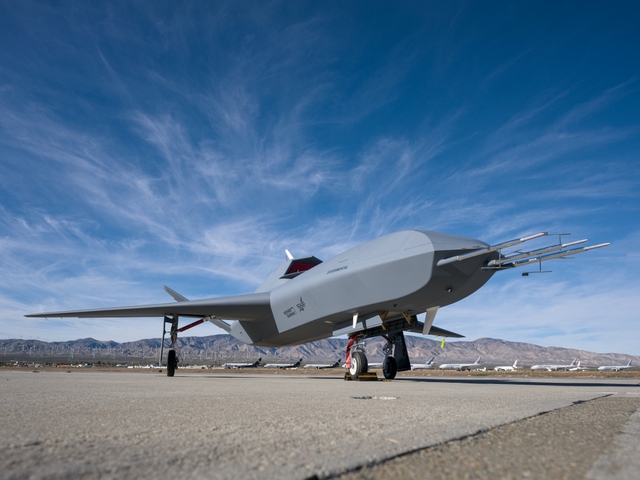
Tom Jones, corporate vice president and president of Northrop Grumman Aeronautics Systems, said in the announcement that the company has focused on building speed and flexibility into the program from the earliest stages. He described the approach as investing ahead of demand, anticipating future mission requirements and establishing the manufacturing capacity to respond quickly.
The YFQ-48A’s inclusion in the Air Force’s CCA initiative highlights the service’s broader strategy to integrate lower-cost, highly capable autonomous aircraft with existing fighter fleets. The program aims to expand combat capacity, increase operational flexibility and reduce risk to human pilots in high-threat scenarios.
With Talon Blue, Northrop Grumman (NOC) seeks to position itself as a key contender in the emerging market for autonomous combat systems, as the Pentagon prioritizes scalable, software-driven platforms capable of adapting to evolving mission demands.
Programs such as the Air Force’s Collaborative Combat Aircraft initiative suggest procurement budgets may increasingly favor lower-cost, attritable platforms that can be fielded in larger numbers, expanding total addressable markets beyond traditional high-end fighter jets.
Companies able to integrate autonomy with digital engineering and rapid manufacturing could capture disproportionate share, while suppliers of sensors, propulsion, secure communications and AI-driven mission systems may also benefit as militaries prioritize speed, survivability and cost efficiency.