Jemal Countess/Getty Images Entertainment
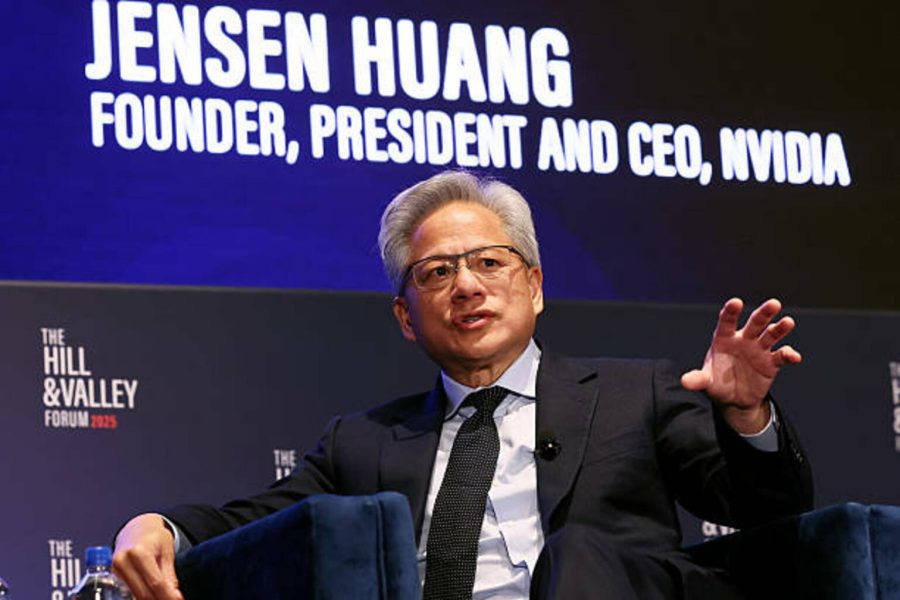
Nvidia’s (NASDAQ:NVDA) CEO Jensen Huang said the U.S. export controls on Ai chips to China were “a failure” as they have cost U.S. companies billions of dollars in lost sales, Reuters reported.
In January, the Biden-Harris Administration unveiled a rule on ‘Artificial Intelligence Diffusion,’ which saw a pushback from Nvidia after it was announced. The rules would create a tier system of countries the U.S. can export high-end processors to and the quantity they can receive. China was among the countries which was blocked entirely.
The Trump administration has noted that it would end the AI Diffusion rule as part of a broader plan to alter semiconductor trade restrictions. In March, major tech companies and senior foreign officials had requested the Trump administration to rethink the nation’s global semiconductor strategy.
“All in all, the export control was a failure,” said Huang adding that “the fundamental assumptions that led to the AI diffusion rule in the beginning, in the first place, have been proven to be fundamentally flawed.”
At a press conference at the annual Computex event in Taipei, Huang praised President Donald Trump’s approach to AI and said by reversing the prior curbs, Trump showed he understands U.S. companies are not the only providers of such technology.
In February, Microsoft had said that the unintended consequence of the proposed tier system would be that allies seeing limited supply of U.S. chips would go elsewhere to get the tech infrastructure they require. “If left unchanged, the Diffusion Rule will become a gift to China’s rapidly expanding AI sector,” Microsoft’s Vice Chair and President Brad Smith had said then in a blog post.
The U.S. curbs on China had forced companies there to buy chips from Chinese companies such as Huawei Technologies. Earlier this month, Huang discussed concerns about Huawei’s growing AI prowess with U.S. lawmakers.
“President Trump realizes it’s exactly the wrong goal,” Huang said at the event in reference to the previous rules.
Huang noted that since the start of U.S. President Joe Biden’s term, Nvidia’s China market share fell to 50% from 95%.
Huang said that over half the world’s AI researchers are based in China and because of the U.S. export curbs on AI chips these experts have been forced to turn to Chinese technology.
“Our competition in China is really intense,” said Huang. “They would love for us never to go back to China.”
Huang forecast the entire AI market in China would be worth about $50B next year, which represented a big opportunity for the company.
At the Computex event, Nvidia announced several new technologies and businesses that would boost its revenue.
In April, Nvidia said it would take $5.5B in charges after the Trump administration noted that the company needs a special license to ship its H20 graphic processing units or related hardware to China.
Earlier this week, Huang noted that the H20-related revenue damage would amount to about $15B, the report added.
Nvidia is working on a type of Blackwell AI chip which will include a comparatively less fast version of memory to adhere with restrictions on the typical advanced memory included on AI chips, the report added, citing people with knowledge of the matter.
Nvidia did not immediately respond to a request for comment from Seeking Alpha.
In October 2023, the U.S. brought in updates to its export restrictions which would curb the sale of chips that Nvidia made for the Chinese market, such as the A800 and H800 chips, as part of Washington’s efforts aimed at hindering China’s access to advanced semiconductor technology. The U.S. has also restricted Nvidia from selling the A100 and more powerful successors, including the H100, in China. This prompted Chinese companies to buy less-powerful Nvidia chips.
China on Monday requested the U.S. to “immediately correct its wrongdoings” and stop “discriminatory” measures after a U.S. guidance warning companies not to use advanced computer chips from China, including Huawei’s Ascend AI chips.
A statement from China’s commerce ministry said that the U.S. action seriously undermined consensus reached at the bilateral trade talks in Geneva. The statement noted that China vows resolute measures if the U.S. continues to “substantially” harm China’s interests.
More on Nvidia
- Do You Really Understand Huawei’s Threat To Nvidia? (Rating Downgrade)
- Nvidia: Roaring Into Q1 Earnings Release After Unjustified Pullback
- Nvidia: Give Respect To The King Of AI
- AMD sells ZT Systems, retains engineers to better compete with Nvidia: Citi
- SA Charts: Semiconductor sales rise in March; China, APAC boosts investments, Americas dip