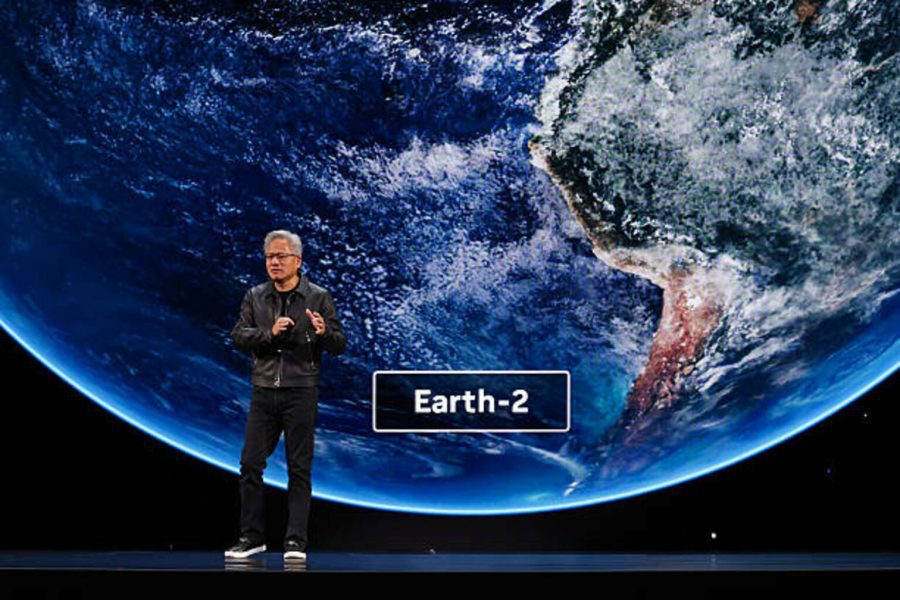
Nvidia (NASDAQ:NVDA) CEO Jensen Huang was not being hyperbolic when he said, “Our GPUs are everywhere,” during his keynote address at the GTC event in Washington, D.C., on Tuesday.
Nvidia shares climbed more than 5% on Tuesday, propelling it above $200.
He outlined the increasing role of Nvidia GPUs in powering artificial intelligence models, telecommunications, quantum computing, enterprise, healthcare, science, energy, consumer goods, robotaxis and manufacturing.
“This is all possible because Nvidia is everywhere,” he said.
He highlighted Nvidia’s new partnership with Nokia (NYSE:NOK)(OTCPK:NOKBF). It involves a new product line called Nvidia ARC, or Aerial RAN Computer, which is a wireless communications system running on top of CUDA. Huang said it can place the U.S. at the center of the next revolution in 6G.
Quantum leap
He announced Nvidia NVQLink, which is an open system architecture for tightly coupling GPU computing with quantum processors to build accelerated quantum supercomputers.
“We now realize it is essential to connect a quantum computer to a GPU system to control the errors and have the two computers working side by side,” Huang said. “This is the future of quantum computing.”
Nvidia is working with 17 quantum computing companies on this, including Rigetti (NASDAQ:RGTI) and IonQ (NYSE:IONQ), as well as quantum control system builders such as Keysight Technologies (NYSE:KEYS) to build these hybrid quantum-classical supercomputers.
They are working with the U.S. Department of Energy to build seven more of these hybrid supercomputers to run in U.S. national laboratories to advance scientific breakthroughs.
“Secretary Chris Wright has added a surge of energy to the DOE to help make this happen,” Huang said.
“Maintaining America’s leadership in high-performance computing requires us to build the bridge to the next era of computing: accelerated quantum supercomputing,” said U.S. Secretary of Energy Chris Wright.
Nvidia is partnering with Oracle (NYSE:ORCL) to help build the DOE’s largest AI supercomputer dubbed Solstice. It will feature 100,000 Blackwell GPUs.
AI factories
Nvidia also revealed the build-out of an AI Factory Research Center, which will help lead the next wave of U.S. infrastructure. It will lay the groundwork for building AI gigafactories, which can produce tokens for running AI applications.
“Tokens are the vocabulary of AI,” Huang said. “You can tokenize nearly anything – the spoken word, videos, images, chemicals and even proteins and genes.”
“This is a factory that produces tokens that need to be as valuable as possible at incredible rates and cost-effective,” he added. “These factories never existed before. And what’s inside these factories are thousands and thousands of chips.”
Nvidia is also building out its Omniverse, or digital twin, libraries that will help run physical AI. Partners for this include Cadence Design Systems (NASDAQ:CDNS), Siemens (OTCPK:SIEGY), Schneider Electric (OTCPK:SBGSF), Vertiv (NYSE:VRT) and others.
Enterprise and security
Huang revealed new partnerships with Palantir (NASDAQ:PLTR) and CrowdStrike (NASDAQ:CRWD).
Palantir Ontology, at the core of the Palantir AI Platform, or AIP, will integrate NVIDIA GPU-accelerated data processing and route optimization libraries, open models and accelerated computing. It will be a “first-of-its-kind integrated technology stack for operational AI — including analytics capabilities, reference workflows, automation features and customizable, specialized AI agents — to accelerate and optimize complex enterprise and government systems.”
“We are partnering CrowdStrike to make cybersecurity the speed of light,” Huang said. “They will have incredibly good AI agents in the cloud, on-prem and on the edge.”
Robots and US manufacturing
Huang highlighted the rise of the robots, and it starts immediately in the robotaxi industry. Nvidia’s Drive AGX Hyperion 10, a reference compute and sensor architecture that makes any vehicle level 4-ready, enabling automakers and developers to build scalable AI fleets.
Nvidia announced a new partnership with Uber (NYSE:UBER) to power its vehicles with the Hyperion system. Uber plans to begin scaling its global autonomous fleet by 2027 with 100,000 vehicles.
Nvidia is also collaborating with Stellantis (STLA), Lucid (LCID) and Mercedes-Benz (OTCPK:MBGAF) to create autonomous-ready vehicles.
He also mentioned Disney Research’s (NYSE:DIS) Blue robot, which is powered by Nvidia processors.
Healthcare
The company is working with Johnson and Johnson (NYSE:JNJ) to build medical robots capable of performing precision non-invasive surgeries and other procedures.
Eli Lily (NYSE:LLY) is developing an AI-powered factory for drug discovery using the Blackwell-Based DGX SuperPOD. It will be the most powerful supercomputer owned and operated by a pharmaceutical company.
Bringing it home
Huang noted that the importance of AI, along with pressure from politicians, is helping bring back U.S. manufacturing.
“We are manufacturing in America again,” Huang said. “It is incredible. We want the security. We want the jobs. We are now manufacturing in Arizona – it took nine months.”
He said Caterpillar (NYSE:CAT) is partnering with Nvidia to build a robotic factory in the U.S.
Foxconn (OTCPK:FXCOF) is also a critical partner, helping build an Nvidia factory in Houston, Texas.
“AI is not a tool,” Huang said. “AI is work. AI is, in fact, workers that can actually use tools.”
And it appears these new AI workers will soon be involved in nearly every facet of the U.S. economy, with most powered by Nvidia GPUs.