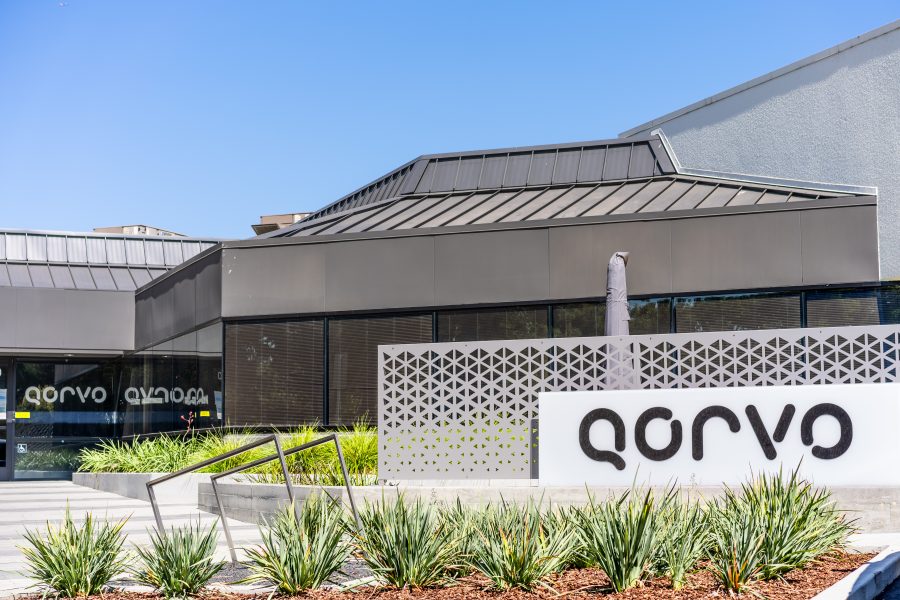
Qorvo’s (QRVO) stock fell about 10% premarket on Wednesday after its fiscal fourth quarter outlook came in below estimates, while analysts remained largely neutral on the stock.
Shares of Skyworks Solutions (SWKS), which is acquiring Qorvo in a $22B cash and stock deal, tumbled about 11%. Skyworks is the biggest S&P decliner today. Both Skyworks and Qorvo are major suppliers to Apple (AAPL).
KeyBanc Capital Markets kept its Sector Weight rating on Qorvo — which provides radio frequency and power management solutions.
“QRVO reported strong F3Q (Dec) results that beat, and guided F4Q (Mar) lower. Results were driven by strong iPhone demand, while lowered guidance was driven by weaker Android revs [revenues] from exits of lower-margin business and the impact of memory pricing. For FY27, QRVO revised up anticipated Android rev declines to $300M from $150M-$200M prior,” said analysts led by John Vinh.
The analysts added that regarding Apple content in fiscal 2027, content is expected to be flat as loss of share on the iPhone 18 Ultra-High Band Power Amplifier Duplexer, or UHB PAD, will be offset by higher content on the iPhone 18 with the internal modem with ET Power Management Integrated Circuits, or PMICs, and Mid/High Band, or MHB, share gains in iPads.
J.P. Morgan maintained its Neutral rating but lowered the price target on the stock to $85 from $105.
“Qorvo’s reported solid Dec-Qtr results (revenue/GM/EPS) driven by solid iPhone momentum and growth in its aerospace and defense businesses. For the Mar-Qtr outlook, the team guided for revenues to be down 19% Q/Q, which is well-below consensus expectations. This decline is primarily due to the continued exit from the low-tier Android business, which was more weighted in Q4,” said analysts led by Peter Peng.
The analysts noted that, looking ahead, the company expects the Android business to decline further on the continued exit of low-tier Android business, worsened by rising memory prices on smartphone demand as original equipment manufacturers, or OEMs, adjust their build plans. The analysts added that memory represents a large percentage of low-tier smartphone Bill of Materials, or BOM, cost and is more price sensitive compared to premium phones.
The company now forecasts the low-tier Android business to decline by about $300M in fiscal 2027 (from $675M in fiscal 2026), which is above the prior expectation of a $150M to $200M revenue range, according to the analysts. The analysts added that this aligns with their previous expectations, where they flagged concerns about demand destruction due to higher memory prices in the second half of this year.
“The team is also seeing a flattish revenue profile for Apple in FY27, due to share loss in its ultra high band PAD (we believe to Broadcom, the other supplier) for the upcoming iPhone product cycle, partially offset by content gains for high band PAD in iPads,” said Peng and his team.
As a result, the analysts said, the company expects fiscal 2027 revenues to be down mid-single-digit percentage year-over-year (versus a consensus expectation of up 2% year-over-year). This is driven mainly by the decline in its ACG business, while CSG is expected to be flattish and HPA is expected to grow double-digit percentage year-over-year.