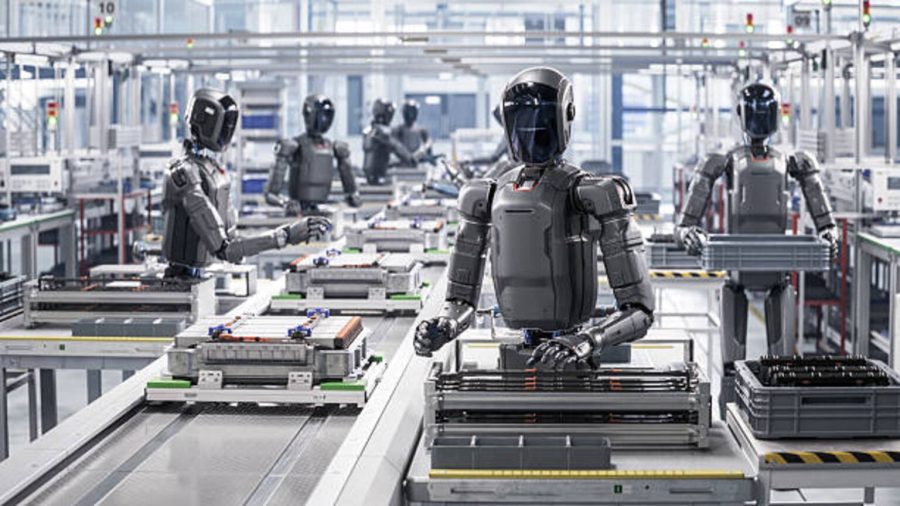
Texas Instruments (TXN) is combining its real-time control, sensing, and power portfolio tools with Nvidia’s (NVDA) advanced robotics computing, ethernet-based sensing, and simulation technologies to help developers build and deploy humanoid robots.
“TI’s comprehensive portfolio bridges the gap between NVIDIA’s powerful AI compute and real-world applications, enabling developers to validate complete humanoid systems earlier in development,” said Giovanni Campanella, general manager of industrial automation and robotics at Texas Instruments. “This integrated approach will help accelerate the evolution from prototypes to commercially viable humanoid robots operating safely alongside humans.”
As part of this collaboration, TI designed a sensor fusion solution by integrating its mmWave radar technology with Nvidia Jetson Thor using Nvidia Holoscan Sensor Bridge to enable low-latency, 3D perception and safety awareness for humanoid robots. Texas Instruments plans to showcase the development during the upcoming Nvidia GTC event, which runs from March 16 through 19 in San Jose, Calif.
“The safe operation of humanoid robots in unpredictable environments requires a massive leap in processing power to synchronize complex AI models with real-time sensor data and motor controls,” said Deepu Talla, vice president of robotics and edge AI at Nvidia.
By fusing camera and radar data, the solution improves object detection, localization, and tracking while reducing false positives for confident, real-time decision-making in humanoid robots, the companies said.
Several U.S.-based companies are working to develop humanoid robots. Tesla (TSLA) is busy developing Optimus, a humanoid bot being built for industrial and consumer uses. Figure AI, which is backed by Microsoft (MSFT) and OpenAI (OPENAI), is attempting to craft a general-purpose humanoid capable of handling all types of tasks.
“These robots can eliminate the need for unsafe and undesirable jobs—ultimately allowing us to live happier, more purposeful lives,” Figure AI said.
Boston Dynamics is hoping its Atlas robot can “revolutionize industrial workspaces.”
However, UC Berkeley professor and robotics expert Ken Goldberg, who also chairs the Berkeley AI Research Lab steering committee, contends in recent journal articles that engineers are years away from building humanoid robots with real-world skill levels.
“We’re all very familiar with ChatGPT and all the amazing things it’s doing for vision and language, but most researchers are very nervous about the analogy that most people have, which is that now that we’ve solved all these problems, we’re ready to solve [humanoid robots], and it’s going to happen next year,” Goldberg said. “I’m not saying it’s not going to happen, but I’m saying it’s not going to happen in the next two years, or five years, or even 10 years. We’re just trying to reset expectations so that it doesn’t create a bubble that could lead to a big backlash.”