
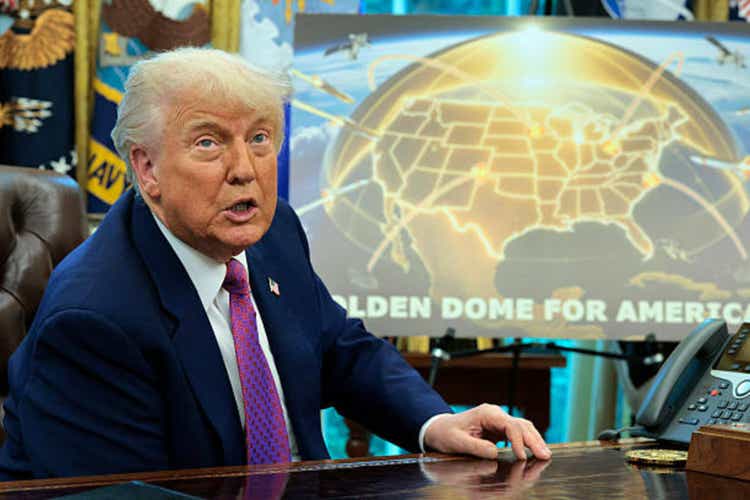
President Donald Trump outlined an ambitious goal: to deploy a global missile defense system, dubbed the Golden Dome, before the end of his term. The proposed $175 billion project aims to defend the U.S. from long-range missile threats using a blend of ground-based interceptors, satellite sensors and experimental space-based weapons.
Some elements of the system such as existing interceptors and orbital detection satellites are already in use. However, defense experts caution that integrating these into a seamless, effective shield is a massive undertaking, The Wall Street Journal reported Sunday. Many of the envisioned technologies are still in early stages of development, and even proven systems are in short supply.
Defense Secretary Pete Hegseth said it’s important to bring the various components into a unified framework, noting that interoperability will be essential to the system’s success. He recently appointed a director to lead the effort.
Costly satellite array
A critical feature of the Golden Dome is a proposed fleet of orbiting satellites capable of neutralizing missiles shortly after launch. Analysts suggest that thousands of such satellites may be required to ensure adequate coverage, raising concerns about both feasibility and cost.
U.S. defense agencies already operate numerous satellites that monitor missile launches, but these assets are spread across multiple branches and operate under separate command structures. Achieving the kind of integration needed for Golden Dome would require major organizational changes and new command-and-control infrastructure.
Major defense contractors like Lockheed Martin (NYSE:LMT) and RTX (NYSE:RTX) are expected to contribute, alongside newer tech-oriented firms such as SpaceX (SPACE), Palantir (NASDAQ:PLTR) and Anduril Industries, which are said to have submitted proposals tied to the initiative. Elon Musk’s SpaceX (SPACE), in particular, is seen as a key player in launching the satellite network, possibly using its next-generation Starship vehicle, the Journal reported.
Missile supply bottlenecks
Experts anticipate that the initial phase of the Golden Dome will involve expanding ground-based missile defense capabilities within the U.S. However, a backlog of missile systems, exacerbated by ongoing conflicts in Ukraine and the Middle East, is already straining supply chains.
Companies like Lockheed (NYSE:LMT) are ramping up output of defense systems such as PAC-3 Patriots and the THAAD interceptor, but these systems are designed for specific threats and have limited coverage areas. Developing and fielding new systems to handle a broader range of threats will take significantly longer.
Meanwhile, Western defense manufacturers face additional hurdles, including labor shortages, complex logistics and high demand from allied nations.
Uncertain price tag, political pushback
Although Trump has projected a $175 billion cost over several years, the Congressional Budget Office has warned the total price could balloon to more than $800 billion, depending on launch costs and other variables. Some lawmakers believe the final tally could run into the trillions over time.
The House of Representatives recently approved a $25 billion initial funding package. But specifics on how those funds would be used are still unclear. Hegseth said the Defense Department is collaborating with the Office of Management and Budget to outline a detailed spending plan ahead of the next federal budget.
Past missile defense projects have often run over budget. A smaller-scale shield planned for Guam has already exceeded $8 billion, largely because of the cost of integrating land and naval defense systems with separate control structures.
Skeptics in Congress have raised concerns about both cost and effectiveness. Sen. Ed Markey (D-Mass.) called the space-based interceptor concept financially irresponsible and argued that it represents more of a windfall for defense contractors than a viable security solution. He instead advocated for renewed emphasis on arms control agreements.
Supporters, however, argue that leveraging existing systems and incorporating new technologies will help limit expenses. Sen. Kevin Cramer (R-N.D.) said that the cost outlook is far more reasonable than critics assume and stressed that many components are already in use — what remains is better coordination and integration, the Journal reported.
More on Lockheed Martin, RTX, etc.
- Holding Steady, Why Palantir Remains A Hold Despite Valuation Concerns
- RTX Corporation: Robust Long-Term Set Up – Wait For Dips
- Palantir: Expect Major Sentiment Upside From The Golden Dome
- Insider trades: Microsoft, AMD, Walmart among notable names this week
- Palantir sees bullish views at Wedbush after $795M US army contract modification