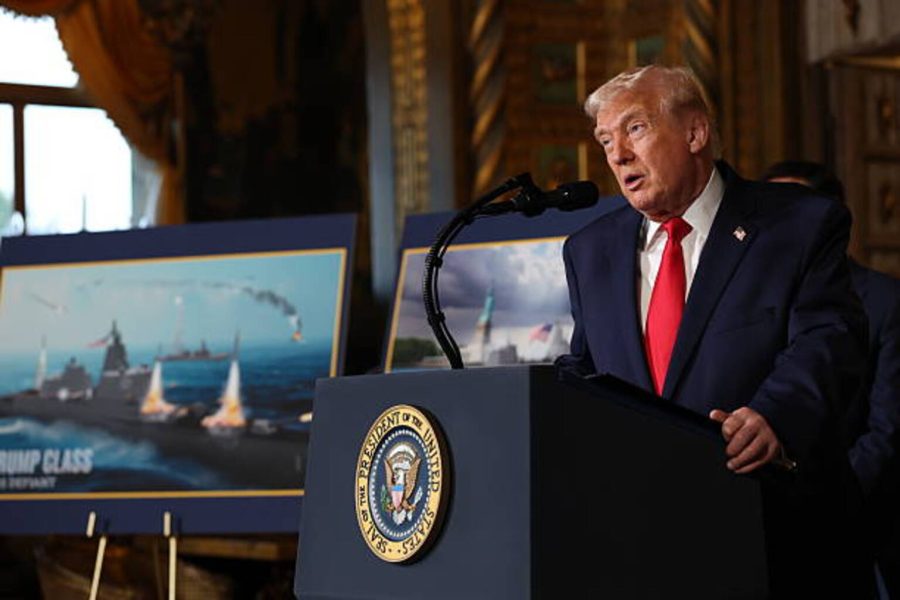
President Donald Trump said Monday that he plans to meet next week with leaders of the nation’s largest defense contractors, signaling an effort to push companies to prioritize weapons development over shareholder payouts and executive compensation.
Speaking at his Mar-a-Lago estate, Trump criticized defense firms for what he described as slow production despite receiving substantial government funding. He said profits should be reinvested in manufacturing capacity and new facilities rather than spent on dividends, stock repurchases or outsized pay packages.
The comments came as Trump also rolled out plans for a new “Trump-class” warship, part of a broader campaign to revive domestic shipbuilding and accelerate weapons production.
People familiar with the discussions said the White House is considering an executive order that would limit buybacks and dividends at major defense companies while tying executive pay more closely to performance in delivering key weapons systems. How enforceable such an order would be remains uncertain and would mark a rare level of federal involvement in corporate governance.
Still, the administration has increasingly pressed defense contractors to align with its priorities, including faster production timelines and lower costs. In some cases, the government has even taken equity stakes to exert influence.
Defense Secretary Pete Hegseth, a close Trump ally, has made overhauling the defense procurement system a central goal, arguing that the current process produces weapons that are late, over budget and sometimes outdated upon delivery. White House Chief of Staff Susie Wiles echoed that view in a recent interview, saying entrenched industry interests pose one of the biggest obstacles to reform.
Major contractors have continued to reward shareholders even as scrutiny intensifies. Lockheed Martin (LMT) recently boosted its dividend and authorized additional share repurchases, while Northrop Grumman (NOC) also pays a regular dividend. At the same time, both companies have expanded investment in manufacturing and advanced weapons programs, including new facilities and research initiatives focused on next-generation systems.