
Summary:
- This week, Tesla CEO Elon Musk again promoted the expectation of a robotaxi service, and the stock price increased.
- ARK Invest further promoted this, saying it anticipated that the robotaxi service would enable Tesla to achieve a $2,000 per share price.
- Enough is enough. This is misleading. Tesla will not be able to offer a robotaxi service.
- While Musk and ARK are correct that autonomous ride-hailing services will be an enormous market, Tesla doesn’t have the right technology or necessary fleet management services to enter the market.
- Companies like Waymo and Cruise already provide these services and show what is necessary.
VCG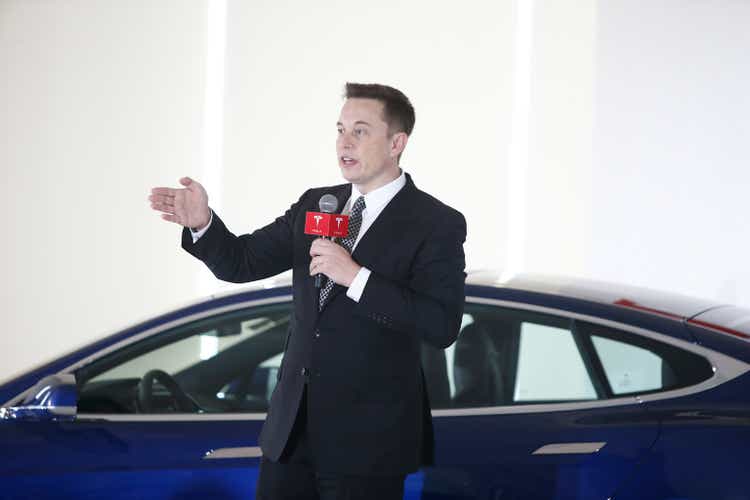
Tesla, Inc. (NASDAQ:TSLA) CEO Elon Musk is once again making claims about Tesla robotaxi, an autonomous ride-hailing service. He envisions a large fleet of Teslas owned by individuals and Tesla itself, operating on the Tesla Network. He believes this could launch by the end of this year or next year.
That won’t happen, and I’ll explain why.
Musk correctly believes that robotaxis will achieve the lowest cost per mile and will displace ridesharing. He is also correct that this will be a huge market opportunity. I’ve written about that in previous Seeking Alpha articles, such as here. But, he is incorrect in believing that Tesla can compete in this market.
In the past, Musk made promises about the Tesla robotaxi. He initially stated it would launch in 2020, claiming that Tesla owners could earn $30,000 per year using their vehicles. He repeated the expectations of “next year” in 2021, 2022, and now 2023.
Cathie Wood, CEO of ARK Invest, is also optimistic about Tesla’s potential to become one of the largest companies in the world by creating a fleet of autonomous robotaxis. “We think that the robotaxi opportunity, globally, will deliver $8 to $10 trillion in revenue by 2030,” she told CNBC, calling it “one of the most important investment opportunities of our lifetimes.” I agree; it could be. Much of ARK’s research is sound, but not its conclusion that Tesla will lead that market.
According to ARK Invest’s April 20, 2023, research report titled “ARK’s Expected Value For Tesla in 2027: $2,000 Per Share,” they estimate that by 2027, 67% of Tesla’s enterprise value and 64% of its EBITDA will be attributed to the prospective robotaxi business. ARK Invest predicts that Tesla could launch its robotaxi fleet to be later this year or in 2024. They firmly believe that Tesla’s robotaxi business has more potential than its automotive sales.
After five years of research, I have concluded that the first three markets for autonomous driving will be autonomous ride-hailing services (robotaxis), autonomous long-haul trucking, and autonomous food and grocery delivery. These markets will utilize the second technology platform described below, not Tesla’s technology platform.
Different Autonomous Driving Technologies
There are currently two primary types of autonomous vehicle technology platforms. This shouldn’t be surprising that there are differences. It’s typical of new technologies. The battle between George Westinghouse and Thomas Edison over AC vs. DC electrical systems is an excellent historical example.
These alternative autonomous driving approaches are different primarily in the method they use to position an AV in its surroundings.
1. Camera-Based Autonomous Driving
A system that is primarily based on cameras is the usual technology used for semi-autonomous driving, and it works very well on highways and similar road systems to take over much of the driving. It is the approach that Tesla uses in its attempt to achieve fully-autonomous driving. This system relies primarily on cameras to determine the specific location of a vehicle. In semi-autonomous driving, the system locates the vehicle within the lanes of a road. This can be a single-lane road with painted lines or a multi-lane highway. Lane-centering software keeps the vehicle in its lane and gradually turns it as the lines curve. Adaptive cruise control sets the speed.
However, the vehicle only knows that it is centered within painted lines and guides it as the lines curve. It has no idea where it is. It could be on a highway in Texas or a city street in Manhattan. Tesla improves on this a little with Navigation on Autopilot which guides the vehicle to exit the highway. It uses GPS to identify where the vehicle is on its route and determines that it is approaching an exit. The vehicle then automatically initiates turning off the exit (directional lights, slowing speed, and turning) when it sees the painted exit lines. However, exiting this way is a little uncomfortable and illustrates the problem with this approach. The vehicle doesn’t slow down until it sees the exit lines, so it could go 70 MPH right until it slows quickly at the exit. In normal driving, most people will slow as they approach the exit.
Camera-based autonomous driving must simultaneously identify the vehicle’s location and build a map of its surroundings. In software terms, this is called simultaneous localization and mapping, or SLAM. Generally, a vehicle uses simultaneous localization and mapping software to estimate its position and orientation while creating a map of its environment. It doesn’t use a predefined high-definition map; it only uses GPS for general positioning.
There are several problems with using this system beyond semi-autonomous driving. The first is turning corners without a detailed map. Unlike highway driving, there may not be painted lines at an intersection for the vehicle to follow to make a turn. It may know from GPS that it is at an intersection, but that is only accurate to a few yards. It needs to build a more detailed map of the intersection while it is there to make the turn, which may not be reliable.
The second problem is a lack of boundaries. This system is unconstrained and allowed to operate on any road in the world, which isn’t feasible. Finally, this system may be too risky. It may not detect critical objects such as stop signs by relying entirely on cameras. If a stop sign is blocked by a truck or something else, the vehicle could keep going through the intersection, although it would avoid a collision.
Most importantly, the camera-based approach to fully autonomous driving has never been proven to work. Semi-autonomous vehicles have driven hundreds of millions of miles on highways. Fully autonomous everywhere is different.
This technology is less expensive than the following approach because it doesn’t require costly lidar. It is also unconstrained and not restricted to geofenced areas. These make it appropriate for individually owned autonomous vehicles that still require a driver in certain situations.
2. Lidar and HD-Maps-Based Autonomous Driving
This second approach is fundamentally different from the previous one. It uses predefined high-definition maps on each AV. These maps very precisely locate (within inches) everything around the vehicle, using lidar to position the AV on the map. The vehicle knows that it is stopped at a stop sign, and it is six inches from a curb that turns 18 inches with a specific radius. The map identifies stop signs, bike lanes, trees, crosswalks, intersection dimensions, etc. The vehicle knows precisely where it is. AVs applying this approach also use cameras and radar to identify moving objects, but positioning is done with lidar and detailed high-definition (HD) maps.
An AV developer must drive all the routes with map-creating software using lidar sensors to create these detailed HD maps. AVs use lidar to identify where they are and position themselves on the HD map. As they move, they continuously reposition themselves on the map. This enables them to turn precisely around corners, stop at stop signs, etc. Going back to the previous example, with this approach, the AV will know that a stop sign is blocked from view because it knows exactly where the stop sign is supposed to be.
The AV is restricted to driving autonomously in areas previously mapped. It won’t be permitted to travel autonomously outside of these boundaries or on unmapped routes. The maps must always be current. If there is a physical change, the map needs to be updated.
The lidar and HD-maps approach has been proven to work. Hundreds of AVs from as many as a dozen developers have driven tens of millions of miles successfully using lidar and HD maps. Vehicles from Cruise and Waymo are now driving autonomously in San Francisco, Phoenix, Austin, and Dallas.
Tesla Has The Wrong Technology For Robotaxis
Tesla’s camera-based autonomous Full Self Driving (FSD) technology won’t work for a robotaxi or autonomous ride-hailing service. As linked above, I’ve written about my experiences with the FSD beta in “How Much Does FSD Impact Tesla’s Valuation?” I won’t repeat the full details here but give a summary.
FSD is impressive and has the potential to become one of the best semi-autonomous driving systems, but it won’t be capable of driving fully autonomously. As I pointed out in my article, some of the issues I experienced can be solved with software improvements, but not all of them.
- For example, the left-hand turn where it could not visually identify that there were three lanes, so it assumed two lanes because it could see cars stopped in those lanes. It then turned into the third lane because it thought it was the correct lane, but there was an oncoming car. The correct lane for the direction it was turning was the next. A system with an HD map would have identified the three lanes and provided the correct turning instructions.
- The examples where the stop sign was not visible to the camera would not have been a problem for the HD map system because it would be identified on the map. FSD just didn’t see it in its field of view, and the vehicle illegally merged into the street without stopping or even slowing down.
- The problem of excessive speed on upcoming curves could be addressed with longer-distance cameras, but they might not be reliable in all cases. The curves would be fully identified with an HD map, and the AV would be instructed to reduce speed as it approached the curve.
- Tricky situations, such as right-turn on red restrictions, can’t be interpreted by a camera. I’ve experienced more than a dozen different signs for right-turn restrictions. Some are a time of day restricted; some are based on a pedestrian crossing. They are placed in vastly different locations and vary in shape. However, they would be properly defined on an HD map.
All the other competitors in autonomous ride-hailing services use HD-map-based technologies. These identify the correct lanes, stop signs, and right-on-red restrictions. They constrain driving to geofenced areas for specific routes and locations. So, in my terminology, they only need to be sufficiently autonomous.
For use as a robotaxi, Tesla vehicles would need to be able to drive everywhere since they don’t use HD maps and can’t be geofenced. They are unrestricted. But they won’t be able to drive everywhere without a driver to take over as needed. The idea that Tesla owners could make their vehicles available as robotaxis and that the vehicles would pull out of their garage on their own and go anyplace to pick up a passenger is untenable and hazardous.
Tesla Doesn’t Have The Fleet Management Capabilities For Robotaxis
Autonomous Ride-Hailing Services (ARS) require a complete platform. Autonomous vehicles are the lower layer of the platform. The top layer is fleet management. This includes ride request and dispatch services such as an app for requesting a ride, dispatch and routing, route adjustment, pick up and drop off location, and customer communications. They need to be able to intervene and assist riders in case there is a problem. There are a lot of local-specific issues that need to be managed.
ARS fleets cover specific municipal locations. Each location needs to get local approvals for autonomous vehicles and charging for rides. They often need to report service and accidents to local government officials.
The fleets need to be maintained. This includes service, charging, repairs, testing, upgrades, and regular cleaning. This requires a physical fleet management center in each location.
Companies like Waymo of Alphabet Inc. (GOOG) and Cruise of General Motors Company (GM) have been building their fleet management centers in each of the cities they do business, and they have found that this takes a lot of work. Tesla doesn’t have these services, and creating them would take a long time. If they go to a model where individually owned Teslas can be dispatched from anywhere to anywhere, then the network would need to operate without any local fleet management, which is not feasible for the near future.
Conclusion
Tesla, Inc. is known for its excellent electric vehicles (EVs) and advanced driving automation but falls short of achieving the fully-autonomous driving required for a robotaxi service. Transitioning from a robust semi-autonomous system to a fully-autonomous one is currently impossible and poses significant safety risks, making it unlikely to be permitted.
I drove a Tesla for 3 1/2 years, beta testing FSD for six months. I really enjoyed it. However, FSD, even with software updates, will not operate fully autonomously everywhere, and that’s what Tesla requires for a robotaxi service because it can’t restrict it.
To establish a successful robotaxi service, companies need sufficiently autonomous driving capabilities within a constrained geofenced area, an HD-map-based technology platform, locally managed vehicle fleets, ride request and dispatch services, and local approvals. Unfortunately, Tesla lacks these essential components.
It is not advisable to invest in Tesla primarily for its future robotaxi prospects, even considering the potential of the autonomous ride-hailing services industry. If you see the enormous opportunity for the autonomous ride-hailing services business, as I do, superior investment options are available. GM Cruise, for example, already provides autonomous rides in San Francisco, Phoenix, and Austin, with upcoming expansion into Dallas and Houston. They have a custom-designed autonomous vehicle ready for mass production.
Surprisingly, GM’s valuation is less than 10% of Tesla’s, despite its more promising position in this new market. If Cruise can enter the robotaxi market while Tesla cannot, there is a potential for General Motors Company stock to jump much higher and for Tesla, Inc. valuation to fall if ARK is correct that 2/3 of Tesla’s future value is expected to come from the robotaxi business.
Analyst’s Disclosure: I/we have a beneficial long position in the shares of GM, GOOG either through stock ownership, options, or other derivatives. I wrote this article myself, and it expresses my own opinions. I am not receiving compensation for it (other than from Seeking Alpha). I have no business relationship with any company whose stock is mentioned in this article.
Seeking Alpha’s Disclosure: Past performance is no guarantee of future results. No recommendation or advice is being given as to whether any investment is suitable for a particular investor. Any views or opinions expressed above may not reflect those of Seeking Alpha as a whole. Seeking Alpha is not a licensed securities dealer, broker or US investment adviser or investment bank. Our analysts are third party authors that include both professional investors and individual investors who may not be licensed or certified by any institute or regulatory body.