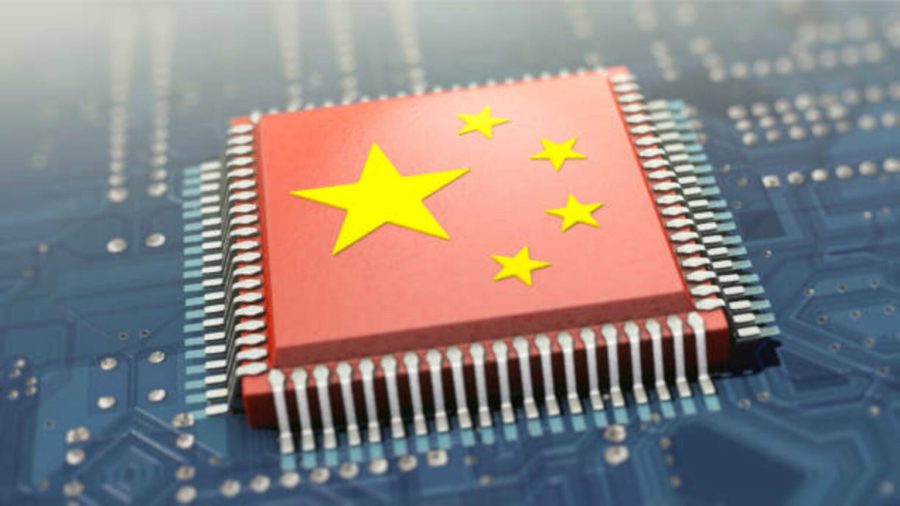
ASML (NASDAQ:ASML) and KLA (KLA) shares fell during Wednesday market action following allegations by the U.S. House of Representatives Select Committee on China that these companies, along with Applied Material (NASDAQ:AMAT), Lam Research (NASDAQ:LRCX) and Tokyo Electron, earned substantial revenue by selling semiconductor manufacturing equipment to Chinese state-owned and military-linked companies.
ASML shares had slipped 1.4%, while KLA had dipped 1.3%. However, Lam Research had inched up 0.7%, and Applied Materials was up 1.6%.
The committee released figures from 2024 showing that Tokyo Electron received 44% of its revenue from China, Lam Research received 42%, KLA received 41%, and ASML and Applied Materials received 36%.
“It makes little sense to sell the CCP the chips they need to modernize their military and violate human rights,” said ranking member Raja Krishnamoorthi, D-Ill. “But it makes even less sense to sell them the machines and tools they need to produce those chips themselves. This bipartisan investigation reveals that the scale of these sales by Dutch, Japanese, and American firms is even more vast than we realized. Alongside our allies, we need to protect our national security and ensure we remain the world’s leading innovators in SME.”
“We must not allow this critical equipment to be handed over to our foremost adversary, or America could lose the technology arms race,” added Chairman John Moolenaar, R-Mich.
Outside of SME companies, stock reactions were mostly positive across semiconductor firms. For example, Broadcom (NASDAQ:AVGO) had edged up 1.4% after it announced advancements in its artificial intelligence networking solutions. This included the Tomahawk 6, Tomahawk Ultra, Jericho4 Ethernet switches, and its third-generation TH6-Davisson Co-packaged Optics.
“By enhancing link stability and energy efficiency, we’re enabling smoother, more cost-effective AI model training,” said Near Margalit, Broadcom’s vice president and general manager of its Optical Systems Division. “We designed this platform to scale large AI clusters by delivering on the three imperatives for optical interconnect: higher model FLOPs utilization, reduced job interruptions, and improved cluster reliability.”
Nvidia (NVDA) had increased 1.6% after its CEO, Jensen Huang, downplayed growing concerns about the AI bubble, differentiating the current surge in investment and valuation in the industry compared to the dot-com bubble in 2000.
Advanced Micro Devices (AMD) also continued its recent surge following its megadeal with OpenAI (OPENAI). Shares for the Lisa Su-led chipmaker jumped 6% by noon trading. They have climbed more than 32% over the past three sessions.
Intel (INTC) had inched up 0.4%, while memory-maker Micron Technology (MU) had increased 5%. Marvell Technology (MRVL) continued its recent rally, climbing 4.5%. Its shares have surged 41.5% over the past month. Qualcomm (QCOM) had increased 1.7%.