Despite beating top and bottom line estimates for Q1 FY2025, tech behemoth Microsoft is down -4% in after-hours trading.
In this note, we discuss Microsoft’s quarterly results, and re-evaluate its long-term risk/reward using TQI’s Valuation Model.
Microsoft has been dead money for 8 months, and this stagnation will need to continue for another 18-24 months for the business to catch up to the stock price.
HJBC
Brief Review of Microsoft’s Q1 FY2025 Report
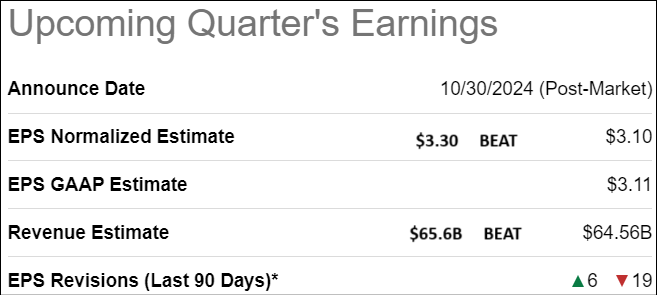
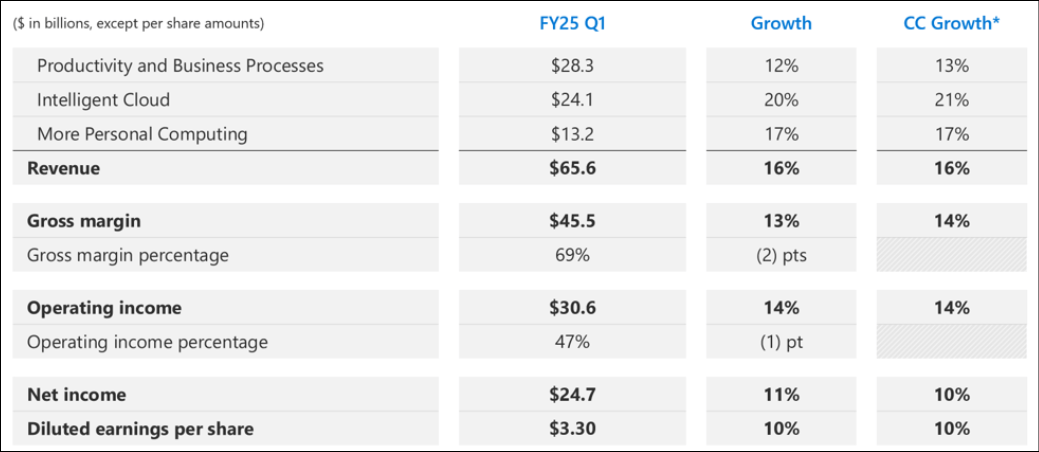
For Q1 FY2025, Microsoft Corporation (NASDAQ:MSFT) beat street estimates on both top and bottom lines, with total revenues coming in at $65.6B (+16% y/y, vs. est. $64.6B) and diluted EPS coming in at $3.30 (+10% y/y, vs. est. $3.10).
SeekingAlpha
On first viewing, Microsoft’s Q1 beat looks significant; however, analyst estimates had been lowered over the past three months – after Microsoft’s management had guided below street estimates back in July:
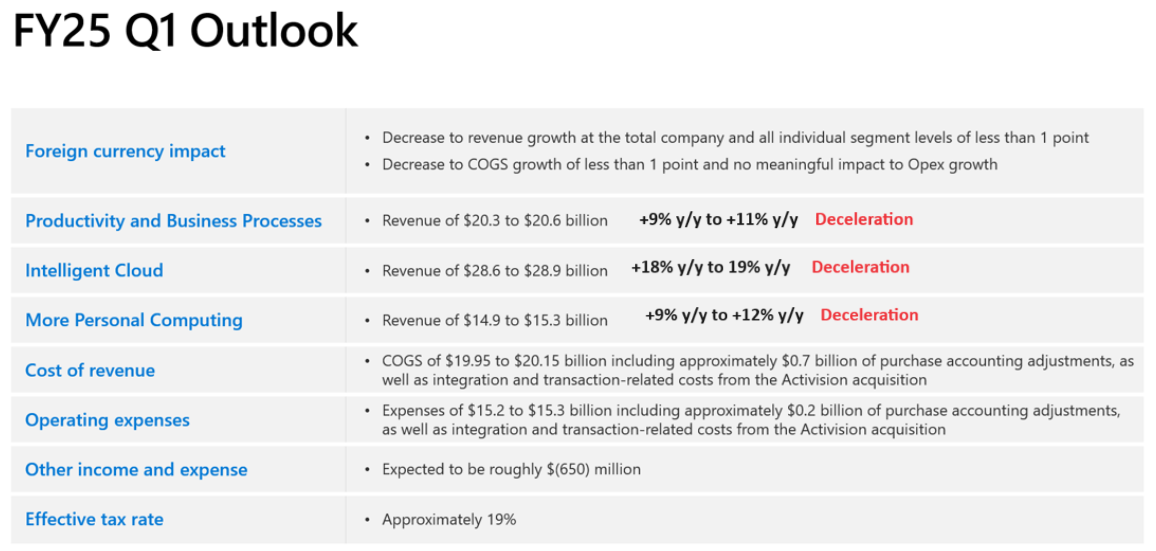
For Q1 FY2025, Microsoft’s management guided for deceleration across the business, with total revenues expected to come in at $64.3B at the midpoint of the guidance range, a figure that fell short of pre-Q4 consensus street estimates for Q1-FY2025 revenue of $65.45B.
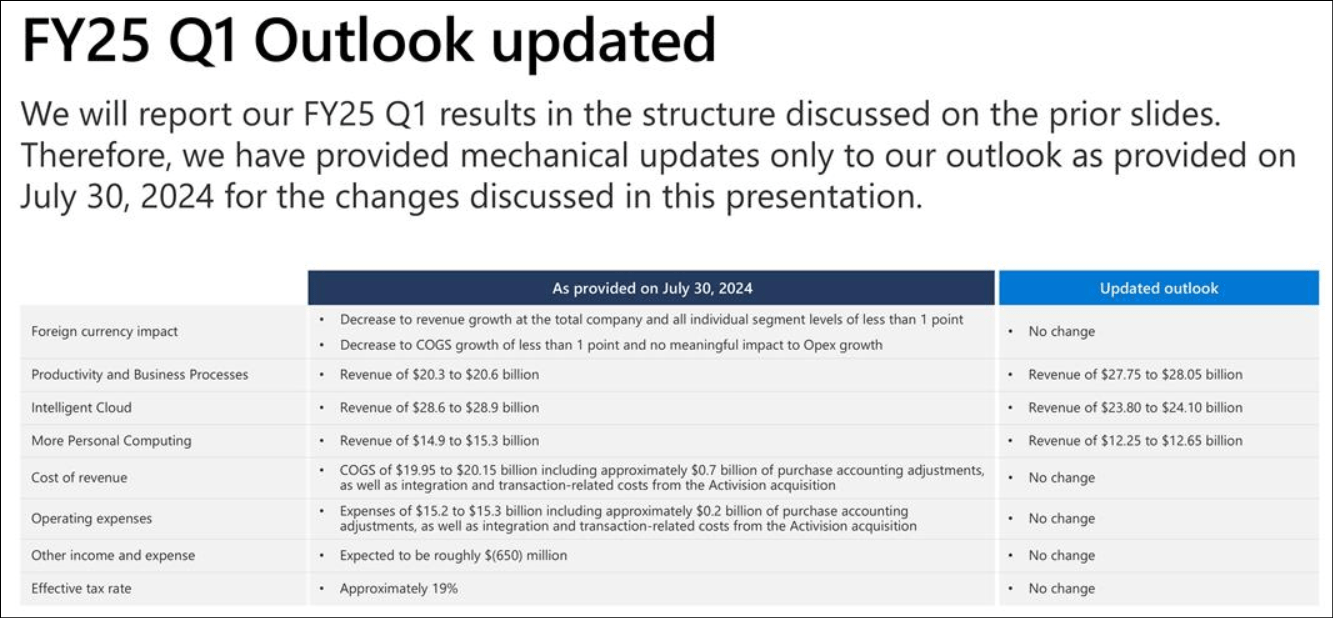
As you can see below, Microsoft’s Productivity & Business Processes [$28.3B, +12% y/y] and More Personal Computing [$13.2B, +17% y/y] exceeded management’s updated guidance ranges for Q1 FY2025, whereas Intelligent Cloud [$24.1B, +20% y/y] came in at the top-end of management’s guided range.
Microsoft Investor Relations
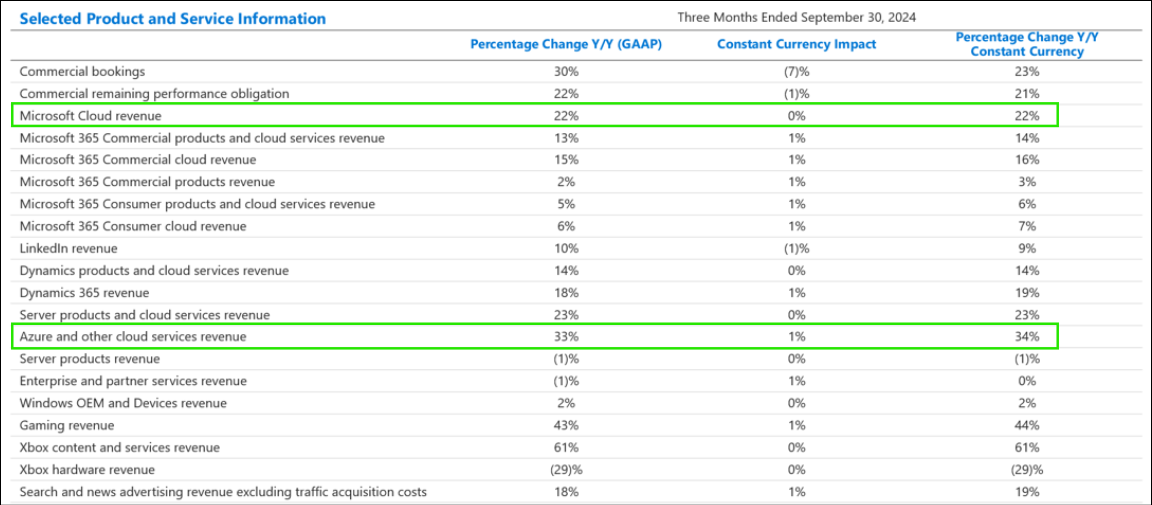
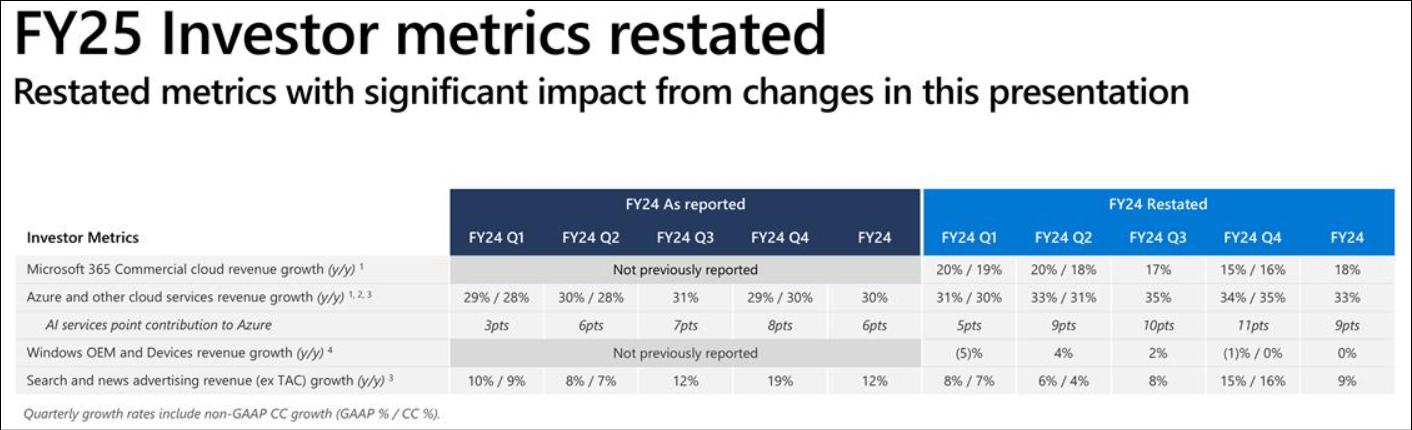
While Azure Cloud’s y/y growth rate of 33% is very impressive [with 12 points attributed to AI revenue], this business saw slight deceleration from [re-stated] 34% y/y growth seen in Q4 FY2024. In contrast, Google Cloud Platform recorded a sharp acceleration from 29% y/y growth in Q2-24 to 35% y/y growth in Q3-24 earlier this week.
Microsoft Investor Relations
Microsoft Investor Relations
Given scale disparity, comparing Azure and GCP is imprudent, but a continuation of this trend could indicate loss of market share for Microsoft. This is something for investors to keep an eye on in upcoming quarters.
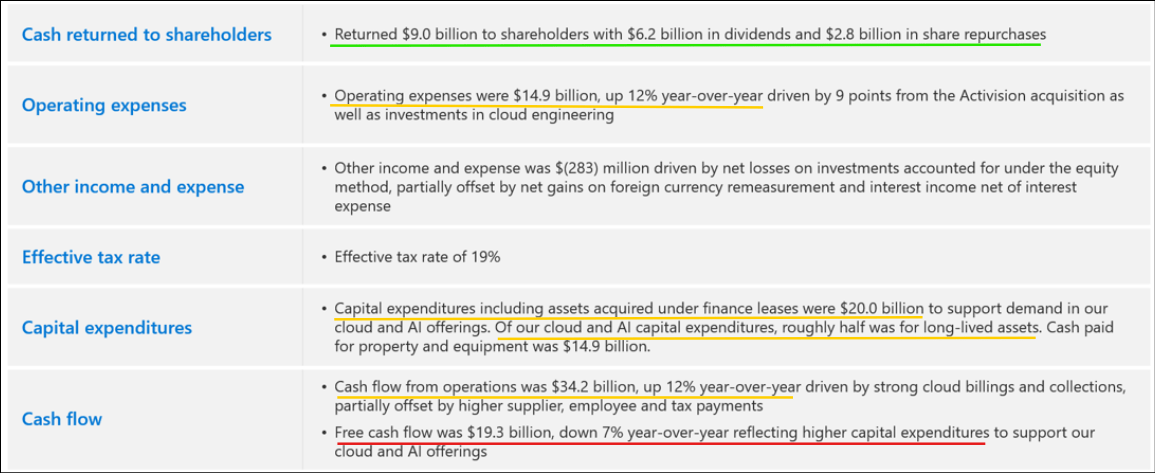
Now, during Q1 FY2025, Microsoft’s operating expenses grew by +12% y/y to $14.9B. With revenue growth outpacing expenses growth, Microsoft generated $34.2B in cash flow from operations (+12% y/y). However, increased CAPEX spending led to a -7% y/y decline in quarterly free cash flow, which came in at $19.3B in Q1 FY2025.
Microsoft Investor Relations
Now, Microsoft returned $9.0B from its free cashflows to its shareholders in Q1 FY2025 through share repurchases ($2.8B) and dividends ($6.2B), showcasing management’s belief in long-term cash generation potential. Microsoft remains a cash printing machine, and I do not view the y/y decline seen in Q1 FCF as the start of a problematic trend – despite a lack of clarity over ROI on ongoing AI CAPEX spend.
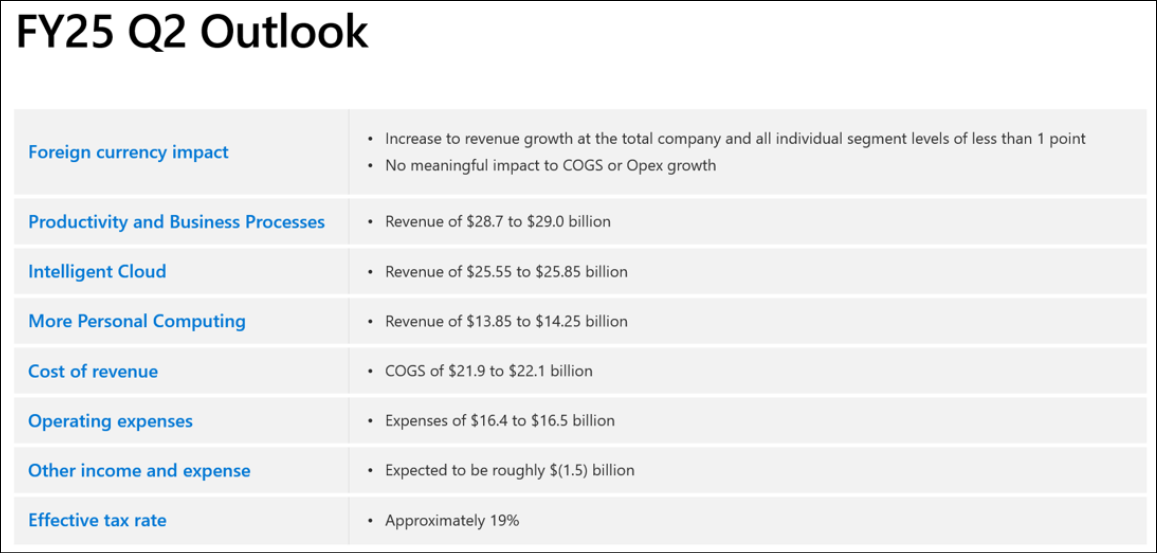
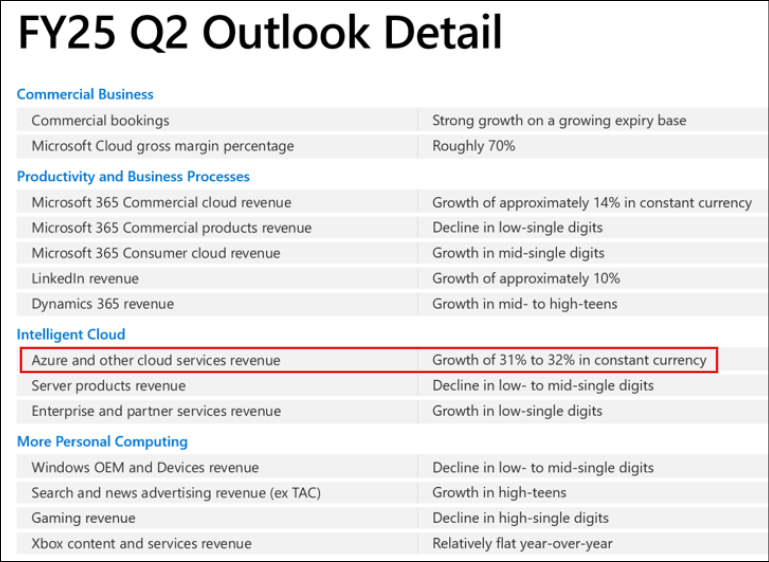
Turning to management’s outlook for Q2 FY2025, Microsoft’s revenue is projected to grow by +10.61% y/y to $68.6B [range: $68.1-69.1B] vs. the pre-Q1 consensus street estimate of $69.85B [+12.63% y/y].
Microsoft Investor Relations
In addition to guiding total revenues below street estimates, Microsoft sees Azure revenue growth decelerating further to the low-30s [31-32% y/y] next quarter. On the earnings call, Microsoft CFO Amy Hood defended this trend by pointing to stable consumption growth trends, but if we take that answer at face value, Azure is facing pricing pressure!
Microsoft Investor Relations
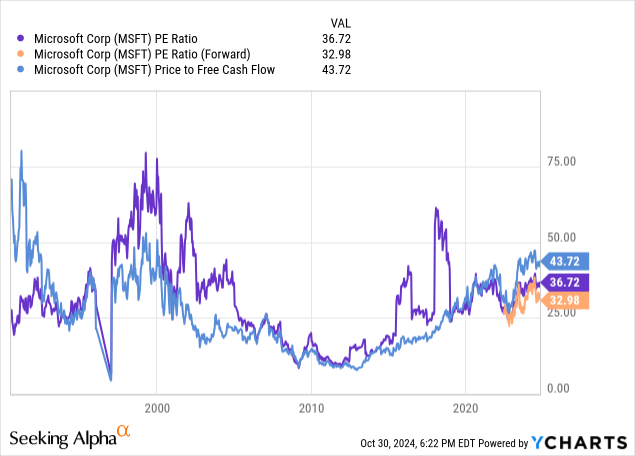
Microsoft is an incredible company, and its Q1 FY2025 performance and forward guidance are respectable. However, I see a significant mismatch between business realities and stock pricing, with Microsoft stock trading at 44x P/FCF and 37x P/E (33x forward P/E) whilst guiding for decelerating, low double-digit growth.
Despite increasing its AI CAPEX spending, Microsoft’s Azure Cloud revenue growth is decelerating. This trend continues to raise question marks over the future ROI on the ongoing CAPEX spending cycle and, in my view, puts a richly valued MSFT stock in the penalty box for the near future.
Concluding Thoughts: Is Microsoft Stock A Buy, Sell, Or Hold Now?
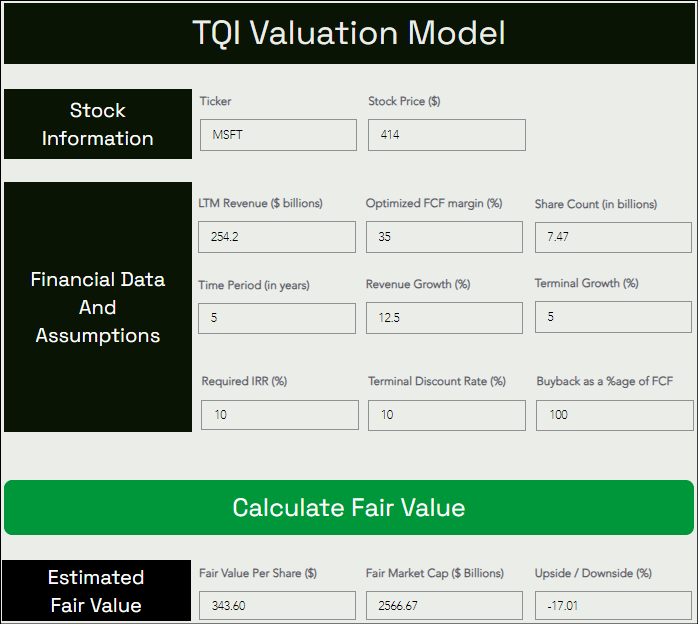
In Microsoft: Bubble, Bubble Toil, And Trouble, I shared detailed reasoning behind our model assumptions for Microsoft. For today’s evaluation, we’re sticking to all of our past assumptions, with the only change coming in the form of the model’s revenue base – TTM revenue now stands at $254.2B
Now, despite using aggressive assumptions for long-term growth and steady-state margins, Microsoft continues to look overvalued by ~17% [after factoring in a -4% post-ER dip in MSFT]:
TQI Valuation Model (Free to use at TQIG.org)
According to our valuation model, Microsoft’s fair value estimate is ~$343.6 per share (or ~$2.57T) [up from $331 per share or ~$2.5T at the last assessment]. With the stock trading at ~$414 per share, I see a downside of -17% to fair value in MSFT stock.
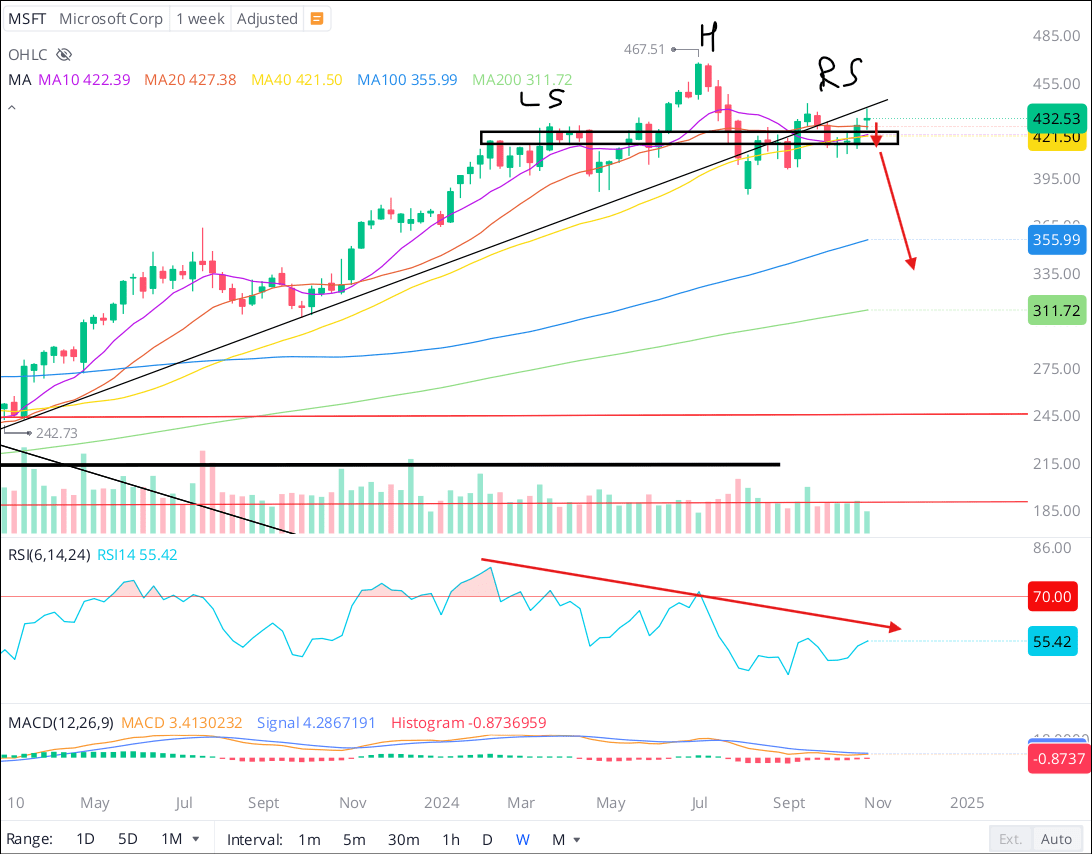
Since February 2024, Microsoft stock has gone nowhere, allowing time for business fundamentals to catch up to its valuation. Based on today’s valuation exercise, I think the sideways consolidation in Microsoft needs to continue for 12-18 months for fair value to catch up to the stock.
On the flip side, Microsoft stock appears to be forming a bearish head and shoulders pattern that could take MSFT down to our fair value estimate. With weekly RSI and MACD indicators rolling over, I wouldn’t rule out a swift 15-20% correction in MSFT stock.
Microsoft Stock Chart (WeBull Desktop)
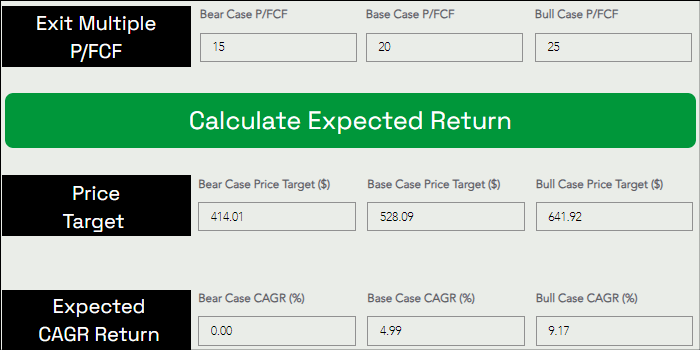
Predicting where a stock will trade in the short term is impossible; however, over the long run, a stock will track its business fundamentals and obey the immutable laws of money. If the interest rates were to return to artificially low levels (i.e., ZIRP), higher equity multiples would be justifiable. However, I work with the assumption that interest rates will eventually track the long-term average of ~5%. Inverting this number, we get a trading multiple of ~20x (P/FCF).
Assuming a base case exit multiple of 20x P/FCF, I see Microsoft stock rising from ~$414 to ~$528 per share in the next five years at a CAGR of 4.99%.
TQI Valuation Model (Free to use at TQIG.org)
Since MSFT’s expected return falls well short of our investment hurdle rate of 15% and S&P 500’s (SPY) long-term average return of ~8-10%, I do not consider Microsoft stock worthy of fresh capital allocation at current levels.
Now, given Microsoft’s 5-year expected return is still better than treasury yields [~4-4.5%]; I am sticking with a “Neutral/Hold” rating on MSFT stock.
Key Takeaway: I rate Microsoft a “Neutral/Hold” in the low-$400s.
Thank you for reading, and happy investing! If you have any questions, thoughts, and/or concerns, please feel free to share them in the comments section below.
Analyst’s Disclosure:I/we have no stock, option or similar derivative position in any of the companies mentioned, and no plans to initiate any such positions within the next 72 hours. I wrote this article myself, and it expresses my own opinions. I am not receiving compensation for it (other than from Seeking Alpha). I have no business relationship with any company whose stock is mentioned in this article.
Seeking Alpha’s Disclosure: Past performance is no guarantee of future results. No recommendation or advice is being given as to whether any investment is suitable for a particular investor. Any views or opinions expressed above may not reflect those of Seeking Alpha as a whole. Seeking Alpha is not a licensed securities dealer, broker or US investment adviser or investment bank. Our analysts are third party authors that include both professional investors and individual investors who may not be licensed or certified by any institute or regulatory body.
We Are In An Asset Bubble, And TQI Can Help You Navigate It Profitably!
Your investing journey is unique, and so are your investment goals and risk tolerance levels. This is precisely why we designed our investing group – “The Quantamental Investor” – to help you build a robust investing operation that can fulfill (and exceed) your long-term financial goals.
At TQI, we are pursuing bold, active investing with proactive risk management to navigate this highly uncertain macroeconomic environment. Join our investing community and take control of your financial future today.